Louisiana and CFTC Clash Over Who Regulates Prediction Markets
A confrontation between Louisiana officials and the US Commodity Futures Trading Commission is sharpening the dispute over who gets to regulate prediction…
Existing US issuers awaiting OCC approval need discretionary relief to keep issuing from Jan. 18, 2027; filing alone is insufficient. Read the full story on CryptoSlateUnderstand the crypto stories that…

Make CryptoSlate preferred on
Share Share
The Office of the Comptroller of the Currency (OCC) outlined a waiver route on Oct. 21 for existing US payment stablecoin issuers awaiting its approval, warning that an application alone will not authorize continued issuance after the GENIUS Act takes effect on Jan. 18, 2027.
Under the new waiver guidance, the OCC generally expects to grant requests to waive prior approval for existing issuers operating in the US that submit substantially complete applications before the effective date. It can still deny a request if its review identifies more compelling reasons to do so.
As of Oct. 21, the OCC’s application page said intake remained closed pending final Office of Management and Budget approval of the information collection associated with the application forms. The agency will announce acceptance in a press release and update the page.
The guidance accompanies the final GENIUS Act framework announced the same day. The final rule also takes effect Jan. 18, 2027.
Under section 15.30(g), eligible applicants must request a waiver in writing and have a substantially complete application pending with the OCC on or before Jan. 18. Substantial completeness means providing enough information for the agency to decide whether the applicant meets the relevant approval criteria.
The eligible groups include subsidiaries whose insured depository institution parents have applied for them, and issuers applying for federal qualified payment stablecoin issuer status.
Relief can run for no more than 12 months beginning Jan. 18, 2027. The agency expects individual waivers to last only as long as necessary to address the applicant’s justification, so applicants cannot assume they will receive a full year.
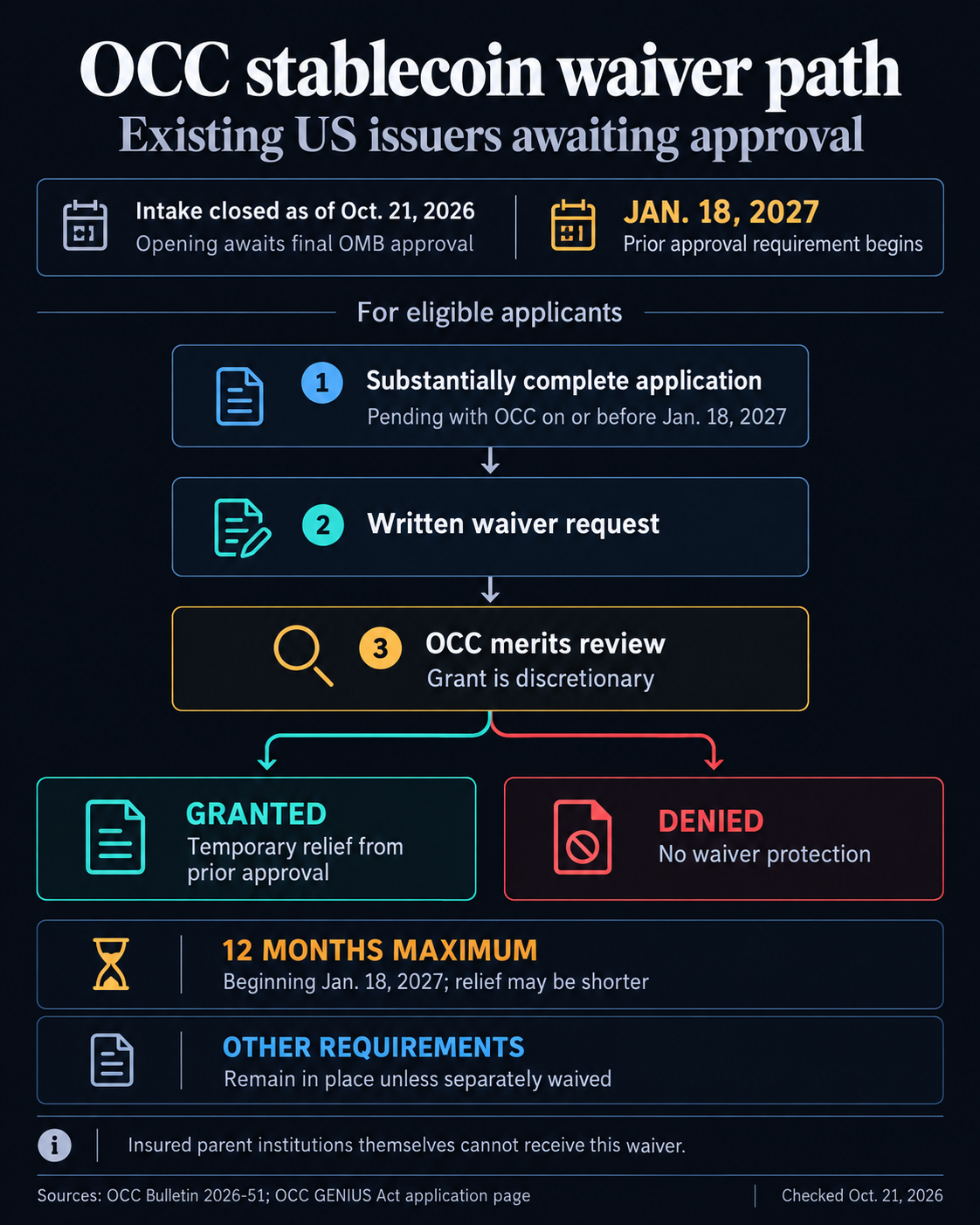
Covered applicants can seek relief from additional provisions they cannot satisfy by the effective date, but the OCC says it has found no compelling reasons that apply generally to granting those requests.
The favorable guidance centers on current US operations. The OCC generally expects prospective issuers to begin operating in the US after approval, and has identified no generally applicable compelling grounds for waivers for issuers that are not already operating or issuing there.
Once intake opens, covered applicants are expected to request waivers as soon as practicable. The OCC says it will evaluate requests on their merits and generally act by Jan. 18.
Even a timely application could leave an existing issuer in violation of the prior approval requirement if it continues issuing without a granted waiver.
Featured US Regulation Stablecoins Banking
Liam ‘Akiba’ Wright Editor-in-Chief • CryptoSlate
Also known as “Akiba,” Liam Wright is a reporter, podcast producer, and Editor-in-Chief at CryptoSlate. He believes that decentralized technology has the potential to make…
X LinkedIn More from Liam Gino Matos Reporter • CryptoSlate
Gino Matos is a law school graduate and a seasoned journalist with six years of experience in the crypto industry. His expertise primarily focuses on the Brazilian blockchain…
Stablecoins
4 min read 3 hours ago
Oct 21, 2026
CryptoSlate may use AI tools to support research, editing, and production workflows. Our journalism remains human-led, with our editorial team responsible for every published article. Read our full AI usage disclaimer.
Our writers’ opinions are solely their own and do not reflect the opinion of CryptoSlate. None of the information you read on CryptoSlate should be taken as investment advice, nor does CryptoSlate endorse any project that may be mentioned or linked to in this article.
Buying and trading cryptocurrencies should be considered a high-risk activity. Please do your own due diligence before taking any action related to content within this article. Finally, CryptoSlate takes no responsibility should you lose money trading cryptocurrencies. For more information, see our company disclaimers.
A confrontation between Louisiana officials and the US Commodity Futures Trading Commission is sharpening the dispute over who gets to regulate prediction…

Nvidia's designation as an AI national champion could reshape industry dynamics, influencing policy support and competitive equity concerns. The post Trump administration…

Anchorage supports institutional XAUT sales and client financing, while direct issuer redemption requires separate eligibility and acceptance. Read the full story on…


The CFTC sued Louisiana Friday to block a state judge's order banning 31 prediction markets, including Kalshi and Polymarket, in the state.