Japan Exchange Group CEO sees limited impact from AI stock selloff
Japan's resilience amid AI stock volatility highlights its potential as a diversification strategy, contrasting with US tech market dependency. The post Japan…
Xaman’s hypothetical return example puts fee recovery near 15 months for 100 XRP, while current vault terms differ. Read the full story on CryptoSlateUnderstand the crypto stories that matter and…
Make CryptoSlate preferred on
Share Share
A first-time 100 XRP deposit through Xaman’s Flare yield route would return about 99.38 XRP after a year in an illustrative calculation using the wallet’s published fees and a constant 2.25% net annual return.
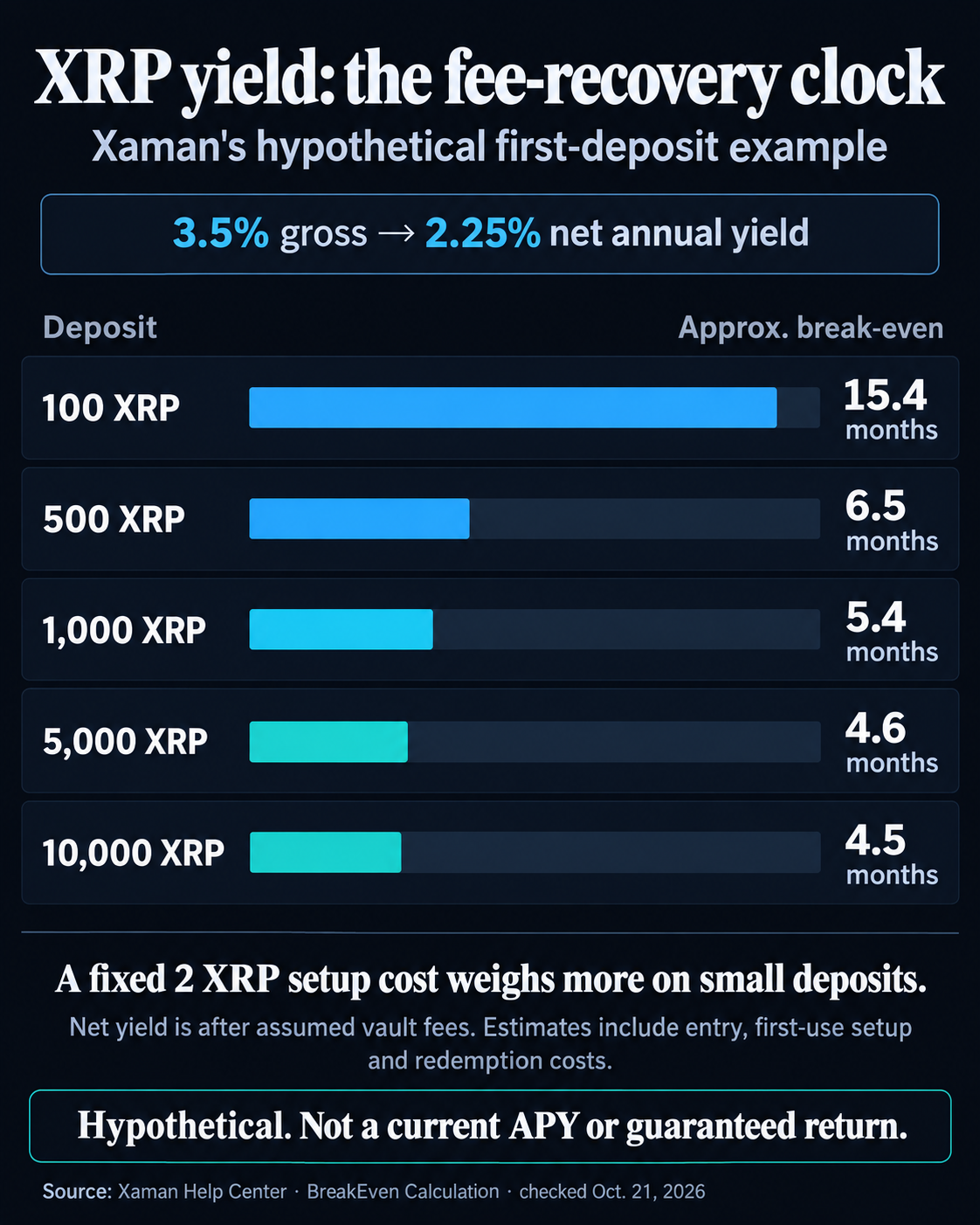
Xaman, a wallet for the XRP Ledger, puts the break-even point at about 15.4 months for that deposit in its hypothetical scenario. The calculation assumes a 2.25% annual return after vault fees and includes the separate entry and redemption costs. For 10,000 XRP, its estimate falls to about 4.5 months. The fixed setup charge takes a larger share of a small deposit, alongside percentage fees on entry and redemption.
The figures in Xaman’s illustration are scenarios, rather than returns customers are assured of receiving. Current terms also differ: the specific earnXRP vault’s public fee data show a lower management charge than the example assumes, while its October 21 trailing yield display is below the example’s net rate.
An October 16 ledger study by XRPL.to brings those costs into focus. The holder’s practical question is how much native XRP returns after an entire investment cycle, and how long the assets must stay deployed to recover the charges.
The documented Xaman route sends native XRP to a Flare-secured account on the XRP Ledger, mints FXRP on Flare and deposits it into earnXRP. Flare is a separate blockchain, where FXRP represents the XRP supplied. The holder receives earnXRP as a receipt for a vault share. Clearstar curates the strategy using infrastructure provided by Upshift.
In its July 28, 2026 update, Flare described a path requiring one XRP Ledger signature, removing separate wallet and gas-token steps. That convenience does not remove the economic costs of entering a different network and an actively managed strategy.
Xaman’s fee schedule lists a 0.5% deposit service charge and a 0.11% FXRP minting charge calculated after the Xaman deduction. Deploying a Flare Smart Account adds a one-time 2 XRP setup cost. Converting FXRP back into native XRP carries a separate 0.2% redemption fee.
For a small deposit, the fixed charge matters immediately. Two XRP is 2% of 100 XRP, against 0.02% of 10,000 XRP. The service and minting charges add further deductions before the remaining balance starts earning.
Xaman exempts yield withdrawals from its own service charge. That exemption does not remove Flare’s redemption charge.
Xaman’s published illustration starts with 3.5% gross annual yield and arrives at 2.25% net after assumed vault costs. Its approximate break-even estimates are 15.4 months for 100 XRP, 6.5 months for 500 XRP, 5.4 months for 1,000 XRP, 4.6 months for 5,000 XRP and 4.5 months for 10,000 XRP.
The example’s 2.25% net rate is consistent with taking a one percentage point management charge from 3.5%, then taking 10% of the remaining 2.5%. That fee order belongs to the illustration.
A separate calculation shows what the assumed 2.25% effective net APY would mean at two holding periods. The table below uses entry deductions consistent with Xaman’s approximate fee table, subtracts the first-use setup charge and applies the 0.2% redemption fee to the ending balance.
Initial XRPXRP returned after 6 monthsXRP returned after 12 months10098.2899.381,0001,0011,012.1910,00010,028.1310,140.32
These are calculated scenarios, assuming successful redemption and a constant return. They exclude additional network costs, any instant-exit premium, taxes, slippage, reward-conversion delays and losses.
The calculation deducts 0.5%, then 0.11% of the remainder, then 2 XRP; it grows the balance at a constant 2.25% effective annual rate before deducting 0.2% on redemption. The fixed-charge placement matches Xaman’s approximate table but is an illustrative convention, not a transaction quote. Compounding creates small differences from its quoted break-even months.
Under that convention, 100 XRP starts with about 97.39 XRP equivalent invested. Immediate redemption would leave about 97.2 XRP before other costs. A positive vault return first fills that shortfall; only afterward can the complete round trip add XRP to the holder’s balance.
The setup charge applies once. If a holder already has the required Smart Account, removing that charge eliminates this particular size disadvantage. Even then, the same model needs about 4.4 months at a constant 2.25% effective net APY to recover the remaining percentage fees.
On October 21, Upshift’s current fee record for Clearstar’s earnXRP vault listed a 0.75% management fee and 10% performance fee. Xaman’s example assumes 1% management. The record listed no fee-waiver dates and is specific to this vault.
The vault page displayed 1.18% Total APY over the trailing 30 days on October 21. That annualized measure is backward-looking. The page also says part of its yield comes from vested rewards called rFLR, discounted in the displayed APY for their vesting schedules. A displayed total therefore cannot automatically be treated as growth in immediately spendable XRP, or as a complete return after wallet entry and exit costs.
Upshift’s APY explanation says share-price returns already reflect fees charged within the vault. Deducting management and performance charges again from that component would count them twice. External wallet, setup, minting and XRP-redemption costs remain separate.
To show sensitivity, if redeemable XRP actually grew at a constant 1.18% effective net annual rate, the same first-use model would take about 29.1 months to restore 100 XRP and 8.5 months to restore 10,000 XRP. Those are conditional calculations, not forecasts from the current display.
XRPL.to’s study reports 34,832 payments charged at 0.5% through its October 16 cutoff, within a category combining large plain payments and yield deposits. That count does not establish 34,832 Flare deposits or unique people, and it does not identify completed Clearstar vault round trips.
The publisher has a commercial interest in wallet economics: it discloses a 0.4% charge on swaps through its own site. Xaman’s service-fee policy independently confirms the general 0.5% yield-deposit charge, while the study’s payment classifications remain its own analysis.
Service charges paid to Xaman go to the provider. They are distinct from the XRP Ledger transaction cost, which destroys the XRP used for that network fee.
Leaving adds another timing question. The current vault page lists no standard withdrawal fee and a two-day withdrawal period. Upshift’s earnXRP guide, updated October 21, describes queued withdrawals within 72 hours and an optional instant route carrying a fee, subject to liquidity. Those provider descriptions differ and do not guarantee when a full conversion back to native XRP will finish.
Xaman’s disclosure also retains smart-contract, cross-chain execution, protocol counterparty and liquidity risks despite user control of keys. A loss or delayed exit can overwhelm a small modeled surplus.
The denomination matters too. XRP traded near $1.36 in CryptoSlate’s October 21 snapshot, down about 9.1% over 30 days. Ending with more XRP would still leave the holder exposed to its dollar price.
The observable test is native XRP received after a completed withdrawal, compared with all XRP committed. Unconverted rewards remain separate, and charges already deducted from proceeds are counted once. Lower entry costs or stronger net returns would shorten the recovery period. For small first deposits, easier access leaves that cost-and-time hurdle in place.
Article context
Related Asset XRP #5 XRP · $1.32 24-hour change: down 2.92% Loading price history… 24H Down 2.92% 7D Up 1.81% 30D Down 14.29% Featured Analysis DeFi
XRP Wallets
Liam ‘Akiba’ Wright Editor-in-Chief • CryptoSlate
Also known as “Akiba,” Liam Wright is a reporter, podcast producer, and Editor-in-Chief at CryptoSlate. He believes that decentralized technology has the potential to make…
Market
3 min read 22 hours ago
Oct 19, 2026
CryptoSlate may use AI tools to support research, editing, and production workflows. Our journalism remains human-led, with our editorial team responsible for every published article. Read our full AI usage disclaimer.
Our writers’ opinions are solely their own and do not reflect the opinion of CryptoSlate. None of the information you read on CryptoSlate should be taken as investment advice, nor does CryptoSlate endorse any project that may be mentioned or linked to in this article.
Buying and trading cryptocurrencies should be considered a high-risk activity. Please do your own due diligence before taking any action related to content within this article. Finally, CryptoSlate takes no responsibility should you lose money trading cryptocurrencies. For more information, see our company disclaimers.
Japan's resilience amid AI stock volatility highlights its potential as a diversification strategy, contrasting with US tech market dependency. The post Japan…

Japan's resilience amid AI stock volatility highlights its potential as a diversification strategy, contrasting with US tech market dependency. The post Japan…

Alexandr Wang, Meta’s chief AI officer, warned on Sunday that superintelligence is arriving. He built the case on a proof of the…
AI's potential to compromise nuclear systems underscores the urgent need for robust human oversight and international cooperation to prevent escalation. The post…