Ethereum has a 25-day wait to start staking, with nearly 1.5 million ETH in line – CoinDesk
Ethereum has a 25-day wait to start staking, with nearly 1.5 million ETH in line CoinDesk
The SPHINCS- proposal aims to reduce the cost of post-quantum signature verification on Ethereum while the network works toward a longer-term solution.


 Written by Zoltan Vardaistaff writerReviewed by Yohan Yunstaff writerWritten by Zoltan Vardaistaff writerReviewed by Yohan Yunstaff writerEthereum can quantum-proof accounts for just 7 cents, says Ethereum’s Kohaku leadLatest NewsPublishedJun 14, 2026<!–>
The SPHINCS- proposal aims to reduce the cost of post-quantum signature verification on Ethereum while the network works toward a longer-term solution.

Ethereum could begin adding post-quantum protections to accounts for as little as $0.07, without waiting for a hard fork, according to the Ethereum Foundation’s Kohaku project lead Nicolas Consigny.
In a Saturday X post, Consigny shared a paper proposing a cheaper way for Ethereum users to protect their accounts against future quantum-computing threats. The approach adapts SPHINCS+, a post-quantum signature standard developed by the US National Institute of Standards and Technology, to work more efficiently on Ethereum.
Dubbed “SPHINCS-,” the proposal aims to reduce onchain verification costs without requiring a protocol change or precompile. Consigny described SPHINCS- as a bridge toward a future post-quantum signature system dubbed “leanSPHINCS,” which aims to further reduce verification costs through aggregation.
The proposal seeks to address the long-term risk of a quantum threat to Ethereum’s Elliptic Curve Digital Signature Algorithm with a cost-efficient solution that may be deployed before a dedicated hard fork is developed.
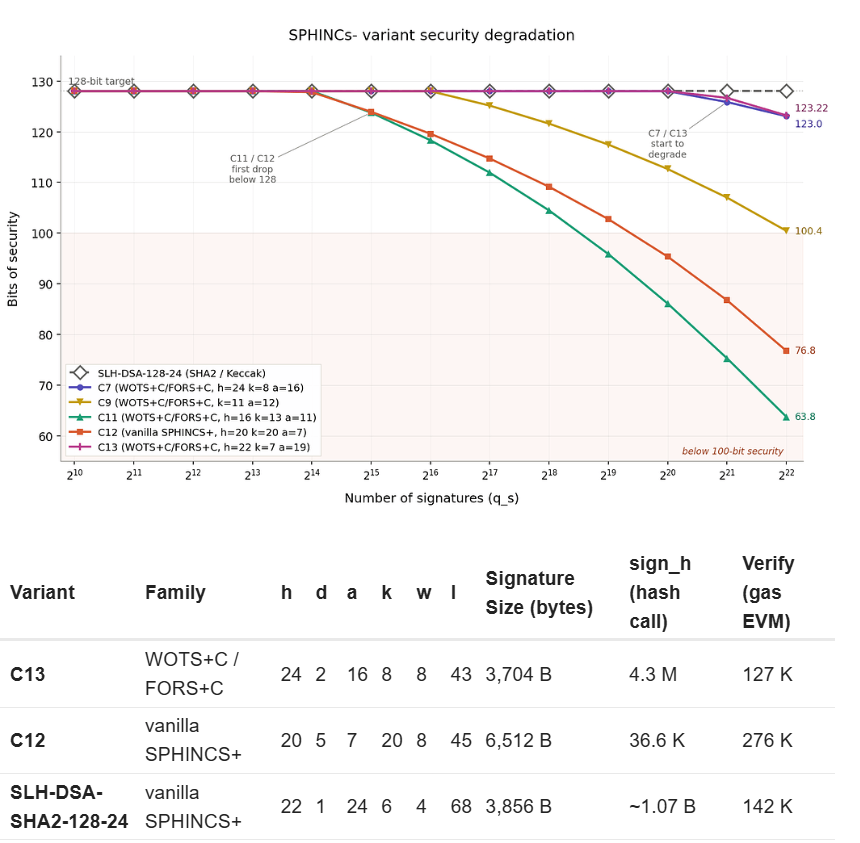
Signature scheme SPHINCs variant security degradation and onchain verification costs. Source: Ethresearch.ch
Related: Adam Back says Bitcoin’s post-quantum shift may reveal true Satoshi stash
In April, post-quantum startup Project Eleven awarded a prize to researcher Giancarlo Lelli for using a quantum computer to break a 15-bit elliptic-curve key.
Bitcoin’s keys are 256 bits long, significantly larger than the 15-bit key Lelli managed to crack. He derived the private key from a public key paired to it, using a variant of Shor’s algorithm, a quantum computing technique that theoretically poses a threat to the type of cryptography used by Bitcoin.
According to Glassnode, about 1.92 million Bitcoin, representing nearly 10% of the total supply, are considered “structurally unsafe” in a future quantum attack scenario. Another 4.12 million BTC, or 20.6% of the supply, are classified as “operationally unsafe” due to key or address management practices.
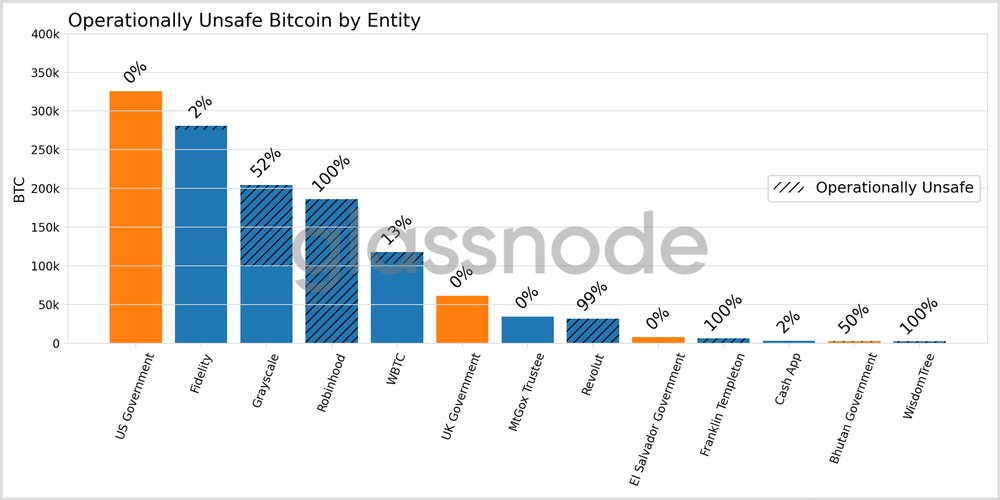
Source: Glassnode
The analytics company estimates that the remaining 69.8% of the supply, or 13.99 million Bitcoin, remains unexposed to a quantum computing threat, broadly in line with Ark Invest’s March estimate that 65% of the supply was safe.
Magazine: Bitcoin vs. the quantum computer threat — Timeline and solutions (2025–2035)
Cointelegraph is committed to independent, transparent journalism. This news article is produced in accordance with Cointelegraph’s Editorial Policy and aims to provide accurate and timely information. Readers are encouraged to verify information independently.
More on the subject
 ETH futures flash bearish signal, but stakers’ resilience points to underlying strength<!–>[–>Jun 13, 2026Marcel Pechman<!–>[–>
 ETH futures traders lean into $1.6K range lows: Will Ether lead market recovery?<!–>[–>Jun 11, 2026Biraajmaan Tamuly<!–>[–>
 ETH crash to $1K looms if key support breaks: Will futures traders step in?<!–>[–>Jun 9, 2026Biraajmaan TamulyETH futures flash bearish signal, but stakers’ resilience points to underlying strength<!–>[–>Jun 13, 2026Marcel Pechman<!–>[–>ETH futures traders lean into $1.6K range lows: Will Ether lead market recovery?<!–>[–>Jun 11, 2026Biraajmaan Tamuly<!–>[–>ETH crash to $1K looms if key support breaks: Will futures traders step in?<!–>[–>Jun 9, 2026Biraajmaan Tamuly
Ethereum has a 25-day wait to start staking, with nearly 1.5 million ETH in line CoinDesk
The past week was entirely different than the previous one.

Chainlink’s recovery remains constructive as low reserves support demand and $14.40 emerges as the next key target.


zkAPI offers an exit without server clearance, but challenged spending states, vault pauses and note expiry can constrain recovery. The post Vitalik-inspired…