Bitcoin Traders Brace for These 4 Key Macro Events This Week
Here are the four major events likely to matter the most for BTC and the broader crypto market for the week ahead.
Strategy agreed on May 15 to repurchase roughly $1.5 billion principal of its 2029 convertible notes for an estimated $1.38 billion in cash. The firm told investors in its Form…

Strategy agreed on May 15 to repurchase roughly $1.5 billion principal of its 2029 convertible notes for an estimated $1.38 billion in cash.
The firm told investors in its Form 8-K that it may fund the repurchase with available cash reserves, ATM sale proceeds, and/or Bitcoin sale proceeds. Strategy expects to cancel the repurchased notes, leaving about $1.5 billion of 2029 notes outstanding.
The filing adds a new role to Bitcoin on Strategy’s balance sheet as a named funding option for near-term debt obligations.
Strategy built its public identity around relentless Bitcoin accumulation, buying during market downturns, funding purchases with convertible debt, and expanding its BTC pile to 818,869 BTC.
The company’s 10-Q already states that it may sell Bitcoin to satisfy short- or long-term liquidity needs, even when other sources are available, if management determines that selling Bitcoin is more favorable.
The 8-K brings that disclosure language into contact with a specific, near-term obligation.
Once the 2029 note repurchase closes, Strategy still has convertible note put-option dates under which holders may require cash repurchase at 100% of principal plus accrued and unpaid interest.
Put date
Notes
Principal exposure
BTC equivalent at ~$79K
Sept. 15, 2027
2028 notes
$1.01B
~12,770 BTC
Mar. 1, 2028
2030B notes
$2.00B
~25,286 BTC
June 1, 2028
2029 notes, post-buyback
$1.50B
~18,965 BTC
Sept. 15, 2028
2030A + 2031 notes
~$1.40B
~17,747 BTC
June 15, 2029
2032 notes
$800M
~10,115 BTC
Total
~$6.71B
~84,900 BTC
The first arrives Sept. 15, 2027, when $1.01 billion of 2028 notes become putable, equivalent to roughly 12,770 BTC at current prices. Mar. 1, 2028, brings $2 billion of 2030B notes, equivalent to roughly 25,286 BTC.
The next repurchase takes place on June 1, 2028, adding $1.5 billion of 2029 notes, equivalent to 18,965 BTC. On Sept. 15, 2028, it carries approximately $1.4 billion across the 2030A and 2031 series, worth roughly 17,747 BTC.
The calendar closes June 15, 2029, with $800 million of 2032 notes, equivalent to roughly 10,115 BTC. Post-buyback put exposure through June 2029, with approximately $6.71 billion, or about 84,900 BTC at current prices.
These are holder-put rights: options that noteholders may exercise based on market conditions, conversion economics, and refinancing alternatives on each date.
Strategy could fund any exercise through cash reserves, ATM proceeds, refinancing, or Bitcoin sales, and the mix will depend on conditions at each point in the calendar.
Strategy’s own 10-Q notes that market perception of Bitcoin sales could trigger preemptive price movements and impair the company’s ability to use BTC for liquidity, the clearest evidence that the company understands the perception risk inherent in naming Bitcoin as a funding option.
At a Bitcoin price of roughly $79,000, funding the current $1.38 billion repurchase entirely through Bitcoin sales would require about 17,448 BTC, approximately 2.1% of Strategy’s 818,334 BTC holdings.
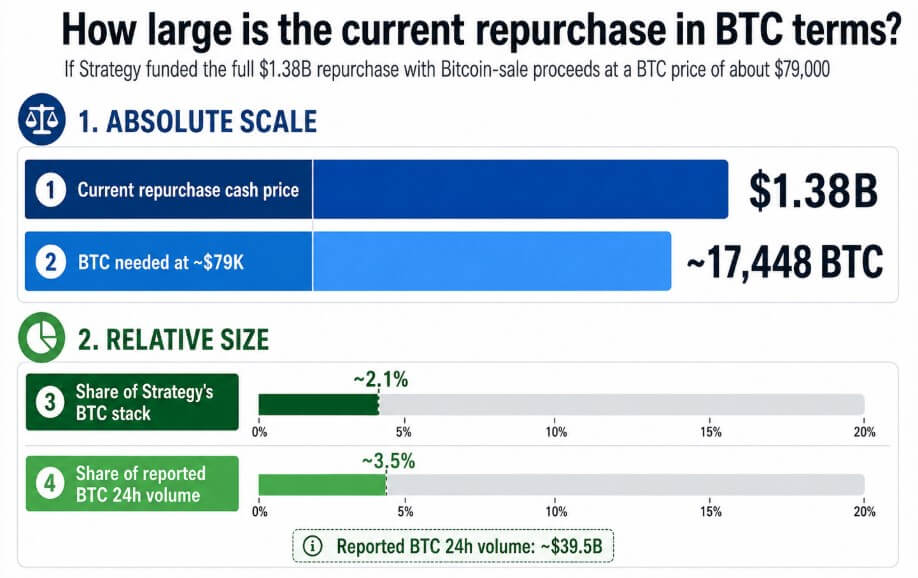
CoinGecko recently reported Bitcoin’s 24-hour volume at around $39.5 billion, making the hypothetical sale about 3.5% of that volume. Routing through institutional OTC desks could limit the immediate exchange-visible effect.
Coinbase’s institutional trading materials describe smart routing as a tool to reduce price effect on large trades and its OTC desk as designed for large, discreet block trades, though counterparty hedging and trader sentiment can still move Bitcoin price independently.
With roughly $2.25 billion in dollar reserves as of Apr. 26, ATM equity issuance, and refinancing all in the toolkit, Strategy has funding capacity to handle the current repurchase without selling Bitcoin.
If Bitcoin falls, equity issuance becomes expensive, and holders exercise put rights in a weak market, the debt calendar becomes a stress test.
Funding the entire $6.71 billion put calendar through Bitcoin sales at current prices would require roughly 84,900 BTC, about 10.4% of Strategy’s stack.
Even partial BTC-funded repayments would attach a sell-flow estimate to each future put date, and Strategy’s own 10-Q identifies that if the market perceives Bitcoin sales, preemptive price movement could impair the very asset Strategy would sell to raise cash, tightening the feedback loop at each subsequent calendar date.
If Strategy completes the current repurchase using cash and ATM proceeds, leaving Bitcoin untouched, it would reduce future 2029 put exposure by roughly $1.5 billion, and the broader calendar would read as routine liability management.
With equity-market appetite for MSTR shares intact and cash reserves in place, the company can treat Bitcoin as a non-monetized treasury position. Each repurchase Strategy routes through non-Bitcoin channels reinforces that reading, and the liquidity-option language in the filings stays theoretical.
Scenario
Funding mix
BTC-market implication
Non-BTC funding
Cash reserves, ATM proceeds, refinancing
Repurchase reads as routine liability management; BTC-sale language remains theoretical
Partial BTC funding
Some BTC-sale proceeds plus cash or ATM
Each future put date becomes a sell-flow estimate; signal risk rises
Full stress case
Entire $6.71B put calendar funded by BTC sales
~84,900 BTC, or ~10.4% of Strategy’s stack, becomes the stress-test number
Strategy’s Bitcoin stack is the world’s largest corporate position, and the company has built multiple liquidity channels to fund its obligations without selling Bitcoin.
The debt calendar stretching to June 2029 gives traders a fixed tool, with each put date a point at which noteholders can force a cash decision, and Bitcoin sale proceeds explicitly on the funding menu.
For now, Strategy’s filings have moved Bitcoin from an accumulation phase asset to a named item in its liability management toolkit, and traders have the dates.
Here are the four major events likely to matter the most for BTC and the broader crypto market for the week ahead.

Here are the four major events likely to matter the most for BTC and the broader crypto market for the week ahead.

Bitcoin is about to get a major bullish signal it hasn't had in over a year CoinDesk
Ethereum's liquidity challenges could lead to increased market volatility, impacting traders' strategies and potentially amplifying price swings. The post Ethereum surges nearly…