Rising Treasury yields threaten Asia’s AI-driven stock rally
Rising Treasury yields may dampen investor enthusiasm, potentially altering asset valuations and impacting broader market stability in Asia. The post Rising Treasury…
According to the latest figures, the stablecoin economy contracted by $2.119 billion during the past seven days, while several of the leading USD-backed coins also posted notable outflows over the…

Crypto NewsPublished:Jun 28, 2026, 10:30 PMCrypto’s Dry Powder Is Drying up as Stablecoin Sector Contracts by $9.4B
According to the latest figures, the stablecoin economy contracted by $2.119 billion during the past seven days, while several of the leading USD-backed coins also posted notable outflows over the last 30 days.
WRITTEN BY Jamie RedmanSHAREPublished: Jun 28, 2026, 10:30 PM
Since May 8, 2026, the stablecoin sector has contracted by $9.445 billion over a 51-day stretch. A declining stablecoin market capitalization is widely viewed as a bearish indicator because it signals more than traders remaining on the sidelines; it suggests capital, or “dry powder,” is actively flowing out of the market.
Seven-day data show the market recorded $2.119 billion in outflows over the past week, with declines spread across USDT, USDC, USD1, USDe, and PYUSD, according to defillama.com statistics.
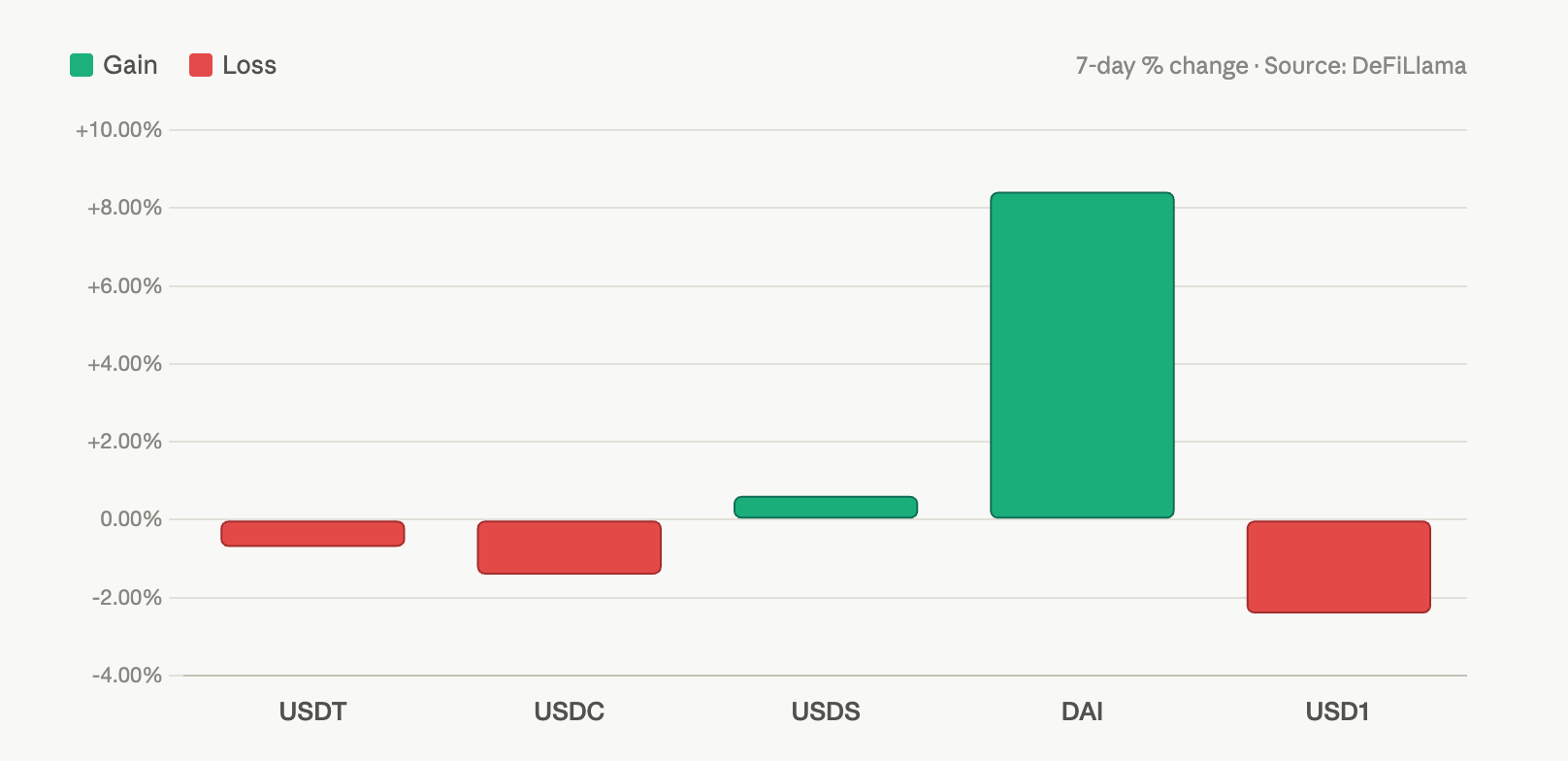
The stablecoin sector now stands at $313.191 billion, with USDT commanding a $184.898 billion market capitalization, giving it a 59.04% share of the entire market.
The bulk of the stablecoin outflows occurred during the past 30 days, with tether ( USDT) shrinking by $3.79 billion since May 28. Circle‘s USDC recorded a $2.419 billion decline, while Sky’s USDS posted a $587 million reduction. Sky’s DAI, on the other hand, bucked the trend by posting a $251 million increase, climbing 5.48% since May 28.
Since May 28, about $69 million has flowed out of World Liberty Financial’s USD1, trimming its supply by 1.45%, while Ethena’s USDe declined 0.69%, or just over $31 million, during the same period. As the total stablecoin supply contracts, the pool of available buying power capable of absorbing selling pressure also diminishes, and this latest stablecoin drawdown has unfolded alongside the broader crypto market decline.
A similar pattern has emerged in the real-world asset ( RWA) sector, particularly among tokens backed by U.S. Treasuries, according to rwa.xyz metrics. During June, the tokenized U.S. Treasuries market declined from $15.86 billion to the current $14.59 billion, and since May 28, it has surrendered 2.58% of its total value. Taken together, the contraction across stablecoins and tokenized Treasury products points to a broader rotation of capital and a meaningful retreat from the market.
How long that trend persists is anyone’s guess.

The 24-hour hold period would allow virtual asset service providers to screen the transactions and verify the legitimacy of the…
Read Now

The 24-hour hold period would allow virtual asset service providers to screen the transactions and verify the legitimacy of the…
Read Now
Read Now
The 24-hour hold period would allow virtual asset service providers to screen the transactions and verify the legitimacy of the…
Tags in this storymarket updatesStablecointokenizationUS Treasury
Rising Treasury yields may dampen investor enthusiasm, potentially altering asset valuations and impacting broader market stability in Asia. The post Rising Treasury…

South Korea's Jeonbuk Bank is set to deploy Ripple Payments as businesses seek faster alternatives to traditional cross-border transfer routes.

User data requests and EU transfer restrictions are changing how crypto works.


In major XRP news today, Ripple and Jeonbuk Bank partner to modernize cross-border payments for South Korea’s regional banking sector. It becomes…