Rising Treasury yields threaten Asia’s AI-driven stock rally
Rising Treasury yields may dampen investor enthusiasm, potentially altering asset valuations and impacting broader market stability in Asia. The post Rising Treasury…
ABcripto, the Brazilian Cryptoeconomy Association, asked the central bank to suspend a proposal to introduce a 24-hour delay for large stablecoin remittances. The organization explained that such a measure would…

StablecoinsPublished:Jul 6, 2026, 2:30 AMAbcripto Blasts Central Bank of Brazil’s 24-Hour Stablecoin Lock as ‘Disproportionate’
ABcripto, the Brazilian Cryptoeconomy Association, asked the central bank to suspend a proposal to introduce a 24-hour delay for large stablecoin remittances. The organization explained that such a measure would affect transparent market actors using regulated entities, while illicit actors would remain untouched.
WRITTEN BY Sergio GoschenkoSHAREPublished: Jul 6, 2026, 2:30 AM
The cryptocurrency sector in Brazil is now facing fierce regulatory oversight that seeks to block the use of stablecoins for illicit purposes with stringent compliance measures.
ABcripto, the Brazilian Cryptoeconomy Association, which groups industry giants such as Binance, Coinbase, Crypto.com, and Tether, has introduced a document opposing an earlier proposal by the central bank, which recommended a 24-hour lock window for stablecoin remittances.
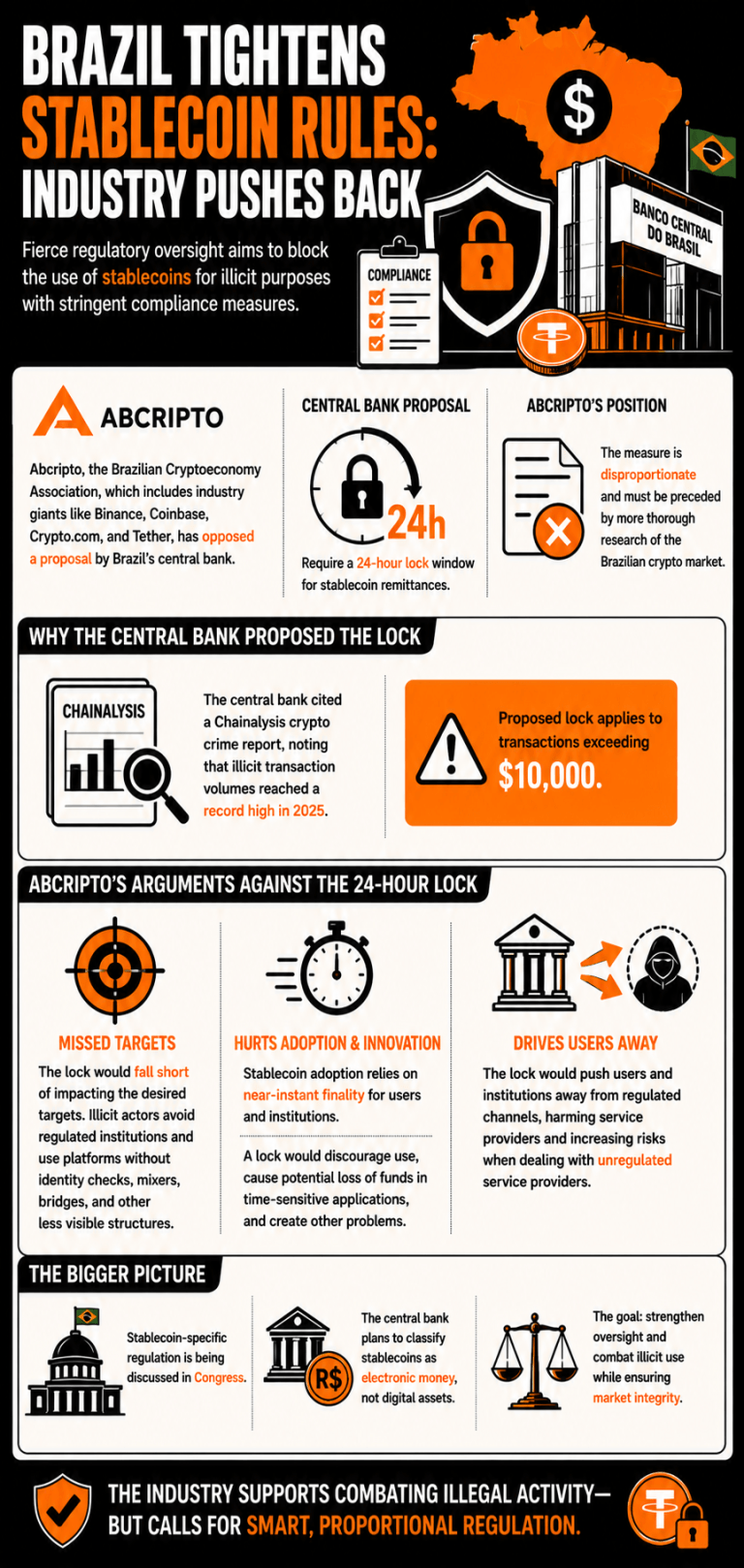
According to local media, in a letter sent to the Department of Financial Regulation (Denor), ABcripto agrees that regulatory groups must pursue fraudulent and illicit activity, but argues that this measure is disproportionate and must be preceded by more thorough research of the Brazilian cryptocurrency market.
As justification for this 24-hour lock on transactions exceeding $10,000, the bank cited a Chainalysis crypto crime report, noting that illicit transaction volumes had reached a record high in 2025.
For ABcripto’s President, Julia Rosin, the measure would fall short of impacting the desired targets. It would instead affect transparent institutions, as illicit actors steer away from these institutions and tend to rely on platforms without identity checks, mixers, bridges, and other less visible structures.
The lock would also affect the current adoption of stablecoins, which is powered by users and institutions that rely on near-instant finality for their use cases. A lock would disincentivize the use of these alternatives, as it could cause loss of funds in time-sensitive applications and other issues.
Finally, ABcripto claims that this would push interested parties away from regulated channels, hurting institutions providing services to their partners and also affecting the security of these parties when transacting with unregulated service providers.
The pushback comes at a time when stablecoin-specific regulation is being discussed in Congress, with the central bank set to classify these instruments as electronic money instead of the current digital asset classification.

The 24-hour hold period would allow virtual asset service providers to screen the transactions and verify the legitimacy of the…
Read Now

The 24-hour hold period would allow virtual asset service providers to screen the transactions and verify the legitimacy of the…
Read Now
Read Now
The 24-hour hold period would allow virtual asset service providers to screen the transactions and verify the legitimacy of the…
Tags in this storyBrazilRegulation
Rising Treasury yields may dampen investor enthusiasm, potentially altering asset valuations and impacting broader market stability in Asia. The post Rising Treasury…

South Korea's Jeonbuk Bank is set to deploy Ripple Payments as businesses seek faster alternatives to traditional cross-border transfer routes.

User data requests and EU transfer restrictions are changing how crypto works.


In major XRP news today, Ripple and Jeonbuk Bank partner to modernize cross-border payments for South Korea’s regional banking sector. It becomes…