Money20/20 USA 2026: How Bitcoin, Stablecoins and AI Are Reshaping the Future of Finance
Bitcoin Magazine Money20/20 USA 2026: How Bitcoin, Stablecoins and AI Are Reshaping the Future of Finance From digital ownership to borderless value,…
According to Bloomberg, the digital asset prime broker is refocusing its Singapore strategy and withdrawing its local license application as crypto companies continue to trim costs.


 Written by Sam Bourgistaff writerReviewed by Robert Lakinstaff editorWritten by Sam Bourgistaff writerReviewed by Robert Lakinstaff editorFalconX cuts 10% of workforce amid prolonged crypto market slump: ReportLatest NewsPublishedAug 3, 2026
According to Bloomberg, the digital asset prime broker is refocusing its Singapore strategy and withdrawing its local license application as crypto companies continue to trim costs.

FalconX, the digital asset prime brokerage that acquired crypto ETF issuer 21shares last November, has laid off roughly 10% of its global workforce as it prepares for a prolonged downturn in the cryptocurrency market, Bloomberg reported Monday.
Citing people familiar with the matter, Bloomberg said FalconX is also reshaping its strategy in Singapore by focusing on crypto derivatives trading and plans to withdraw its license application with the Monetary Authority of Singapore. The company intends to maintain its presence in Asia while expanding its European business.
FalconX employed about 350 people across the United States, the United Kingdom, Singapore and Hong Kong before the layoffs.
Cointelegraph contacted a FalconX spokesperson for comment but did not receive an immediate response.
The reported workforce reduction adds FalconX to a growing list of crypto companies scaling back operations during the market downturn, joining exchanges including Coinbase, Crypto.com, Luno and Gemini, and infrastructure provider BitGo.
Related: Ethereum Foundation sacks 20% of workforce amid strategic restructuring
Crypto exchanges have been under pressure as Bitcoin (BTC) and other digital assets retreated from last year’s highs, weighing on trading volumes and retail participation. As Cointelegraph reported, some analysts believe Bitcoin has yet to reach a market bottom, suggesting the industry could face continued headwinds.
Bitcoin was last trading below $64,000, about 50% less than its October peak of about $126,000.
In response, many exchanges are expanding beyond spot trading. According to a recent CoinGecko report, the “crypto TradFi” sector, which includes tokenized assets, derivatives and other traditional financial products, grew fivefold to $6.6 billion between January 2025 and June 2026.
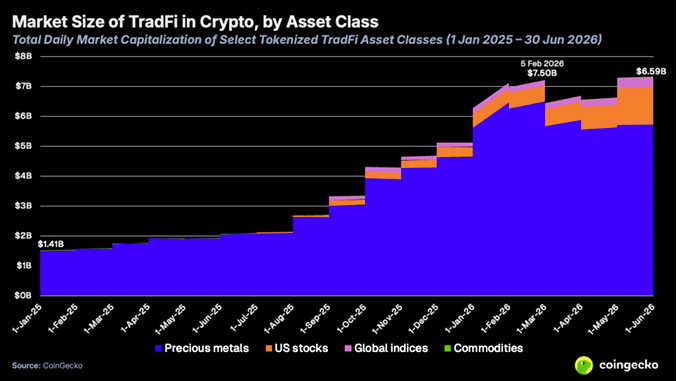
Tokenized stocks and commodities have emerged as leading drivers of crypto TradFi growth. Source: CoinGecko
Coinbase’s latest earnings underscore that shift. Although the company missed earnings expectations, it reported that 88% of second-quarter net revenue came from businesses other than spot Bitcoin trading, with derivatives, prediction markets and tokenized assets playing an increasingly important role.
Magazine: Dubai tops Asian crypto hubs, Taiwan passes crypto laws: Asia Express

 <!–>
<!–>
[–> Subscribe Cointelegraph is committed to independent, transparent journalism. This news article is produced in accordance with Cointelegraph’s Editorial Policy and aims to provide accurate and timely information. Readers are encouraged to verify information independently.
<!–>[–>1 hour agoFelix Ng<!–>[–>
<!–>[–>6 hours agoFelix NgNews Brief<!–>[–>
<!–>[–>19 hours agoYohan Yun
<!–>[–>1 hour agoFelix Ng<!–>[–>
<!–>[–>6 hours agoFelix NgNews Brief<!–>[–>
<!–>[–>19 hours agoYohan Yun
Bitcoin Magazine Money20/20 USA 2026: How Bitcoin, Stablecoins and AI Are Reshaping the Future of Finance From digital ownership to borderless value,…
Managing your crypto taxes can become increasingly complicated as your activity starts spreading across multiple exchanges, wallets, blockchains, and DeFi protocols. CoinTracking…

Here's how investors are rapidly changing the way they seek exposure to major assets.


Eight of 13 cash sessions fell from September 21–October 7, 2026, but boundary checks and opposing ETF flows leave sustained institutional selling…