SpaceX Stock Forecast as Cathie Wood Eyes $10T Starship Opportunity Ahead of September 22 Orbital Flight
SpaceX stock price is in focus ahead of the first orbital flight test that is scheduled to take place on September 22.…
Chainlink has recorded nine new integrations across five blockchains in its latest weekly ecosystem update, adding another set of deployments to its oracle...
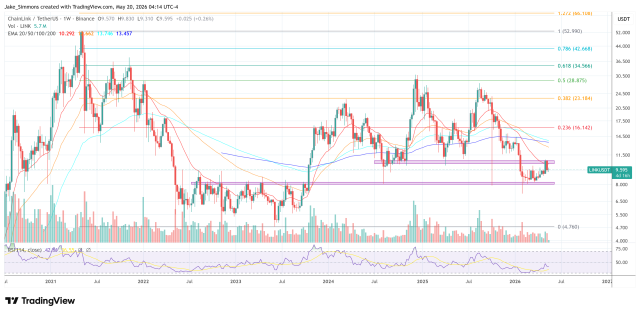
Chainlink has recorded nine new integrations across five blockchains in its latest weekly ecosystem update, adding another set of deployments to its oracle and infrastructure network.
The update covers integrations across multiple services and chains, reinforcing Chainlink’s role as one of crypto’s main data and interoperability providers.
This is not a LINK price prediction.
It is an operational development story. More integrations show that protocols continue to use Chainlink infrastructure, but they do not automatically translate into immediate token price movement.
For more details, visit the official Blog platform.
Chainlink’s business is infrastructure.
Protocols use its services for price feeds, data, automation, proof-of-reserve, cross-chain messaging, and other functions that smart contracts cannot reliably handle alone.
That means integrations are a useful activity signal.
Each new integration shows another application or network choosing Chainlink’s infrastructure layer. One integration may be small. But repeated integration updates can show that Chainlink remains embedded across the market.
That is important in a multi-chain environment.
The five-chain spread matters because crypto is no longer centered on one network.
Applications launch across Ethereum, L2s, alternative L1s, appchains, and specialized ecosystems. Infrastructure providers need to support that fragmentation.
Chainlink’s multi-chain reach is one of its main strengths.
If developers can access familiar oracle services across different environments, it lowers the friction of building across chains. That helps Chainlink remain relevant even as liquidity and users move between ecosystems.
DeFi depends on reliable external data.
Lending markets need asset prices. Derivatives platforms need settlement references. RWAs need off-chain valuations. Stablecoin systems may need reserve or price data. Automated strategies need triggers.
Without reliable oracles, many DeFi products cannot work safely.
That is why Chainlink’s integration updates matter even when they do not sound flashy. They show the continued buildout of the data layer that many applications rely on.
The market often tries to connect every integration directly to LINK.
That is too simple.
Integrations may increase usage, but token impact depends on fee models, staking design, payment flows, demand for LINK, broader market conditions, and how the services are monetized.
The operational signal is real. The immediate price conclusion is not automatic.
That is the careful way to read the update.
The next question is whether these integrations drive meaningful activity.
A deployment becomes more important when it supports real liquidity, large user bases, high-value assets, or essential infrastructure. Integration count is useful, but usage depth matters more.
Still, Chainlink continues to show breadth.
Nine integrations across five blockchains is another reminder that oracle and data infrastructure remain central to crypto’s growth.
For LINK holders and DeFi builders, the signal is steady rather than explosive: Chainlink remains deeply woven into the multi-chain application stack.
This article is based on Chainlink’s latest weekly integration update.
This article was written by the News Desk and edited by Samuel Rae.
This report is based on information released by Blog. at Blog
SpaceX stock price is in focus ahead of the first orbital flight test that is scheduled to take place on September 22.…

The ongoing conflict exacerbates mental health issues and complicates prospects for peace, impacting regional stability and economic forecasts. The post Lebanese residents…

The persistent U.S.-Iran tensions, without direct negotiations, risk prolonging regional instability and impacting global geopolitical dynamics. The post US-Iran tensions persist with…

Standard Chartered gave a $10 target for ARB by 2030, a 66x increase from current market prices.