Money20/20 USA 2026: How Bitcoin, Stablecoins and AI Are Reshaping the Future of Finance
Bitcoin Magazine Money20/20 USA 2026: How Bitcoin, Stablecoins and AI Are Reshaping the Future of Finance From digital ownership to borderless value,…
Tesla shares fell 6% while the NHTSA audited how its driverless Cybercab satisfied federal safety standards on public streets in Austin. The post Tesla drops 6% as Cybercab faces federal…
Tesla Cybercabs stock crashed 6% in an hour this morning following news of a compliance audit.
Yesterday, Tesla commercially deployed Cybercabs onto public streets in Austin, Texas. By the end of the day, the National Highway Traffic Safety Administration (NHTSA) quietly opened a new probe, Audit Query AQ26002, of up to 1,000 Tesla vehicles, which would more than cover the company’s Cybercab fleet of only a few dozen vehicles.
Tesla stood behind its claim that “Cybercab is engineered to be the safest car on the road.”
The NHTSA doesn’t typically pre-approve vehicles for compliance with Federal Motor Vehicle Safety Standards (FMVSS).
Manufacturers self-certify compliance with FMVSS standards, or request a limited exemption in advance.
Whenever the NHTSA suspects non-compliance with FMVSS standards, the agency may probe conduct and pursue remedies. In Tesla’s case, the NHTSA said it “is opening this AQ to examine the process and technical data on which Tesla relied when certifying the Cybercab and related issues.”
Cybercab has no permanently attached steering wheel, brake pedal, accelerator pedal, or rearview mirrors. In Tesla’s view, these omissions make the car look futuristic and are safe.
An Audit Query is not an allegation of misconduct. The NHTSA’s Cybercab notice doesn’t announce a recall or any current determination of noncompliance.
Read more: CHART: Value of Tesla’s BTC holdings have fallen by two-thirds
Last year, the NHTSA announced three proposed rules for automated vehicles without manual controls.
Its existing route allows manufacturers to sell up to 2,500 vehicles per year that don’t fully comply with traditional FMVSS.
Zoox is a recent example of an NHTSA audit ending unremarkably. In its case, the NHTSA closed its self-certification inquiry in August 2025, delivering a list of requests to Zoox that the company fulfilled. Zoox then received a formal, temporary FMVSS exemption for its commercial deployment that began July 2026.
Zoox may legally operate cars on public roads under this exemption.
Tesla chose the bolder route. It began commercial deployment with a self-certification, rather than proactively applying for a special exemption.
Tesla didn’t immediately respond to Reuters’ request for comment on yesterday’s NHTSA audit.
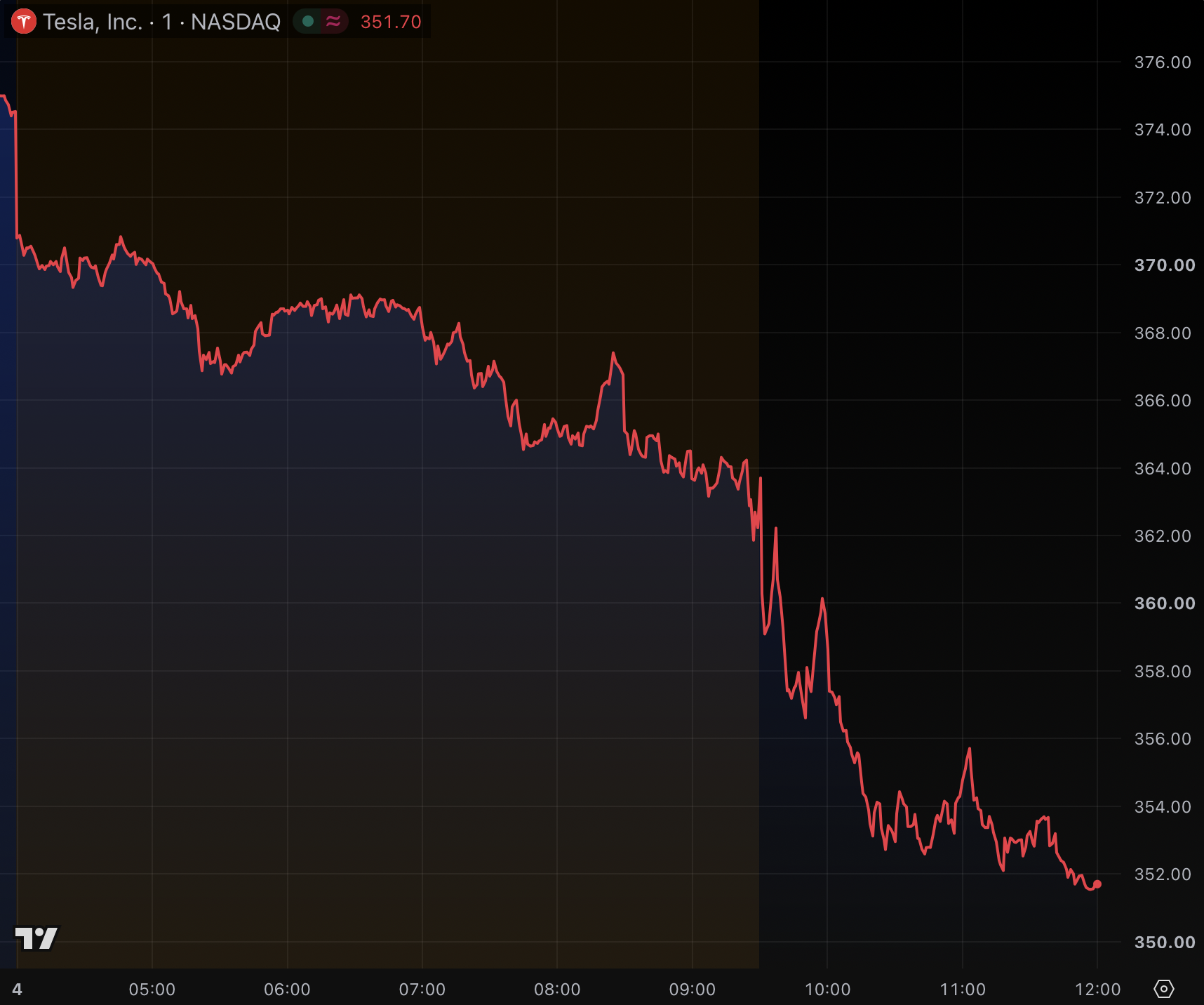
By noon in Nasdaq’s trading session today, shares of Tesla were trading 6.5% below yesterday’s closing price despite a relatively sideways Nasdaq 100 index at -0.5%.
Got a tip? Send us an email securely via Protos Leaks. For more informed news and investigations, follow us on X, Bluesky, and Google News, or subscribe to our YouTube channel.
Bitcoin Magazine Money20/20 USA 2026: How Bitcoin, Stablecoins and AI Are Reshaping the Future of Finance From digital ownership to borderless value,…
Managing your crypto taxes can become increasingly complicated as your activity starts spreading across multiple exchanges, wallets, blockchains, and DeFi protocols. CoinTracking…
Here's how investors are rapidly changing the way they seek exposure to major assets.


Eight of 13 cash sessions fell from September 21–October 7, 2026, but boundary checks and opposing ETF flows leave sustained institutional selling…