Can Europe’s Zcash ETP keep ZEC above $1600 amid THESE signals?
Zcash’s latest breakout is drawing fresh capital and leverage, pushing ZEC into a closely watched resistance zone.
Cross-border stablecoin transfers surged as the wider crypto market shrank 37%, with Chainalysis pointing to growing use for trade, remittances and savings.


 Written by Felix Ngstaff editorReviewed by Yohan Yunstaff editorWritten by Felix Ngstaff editorReviewed by Yohan Yunstaff editorStablecoin cross-border flows surge 78%, defying crypto bear marketLatest NewsPublishedSep 23, 2026<!–>
Cross-border stablecoin transfers surged as the wider crypto market shrank 37%, with Chainalysis pointing to growing use for trade, remittances and savings.
 –>
–>
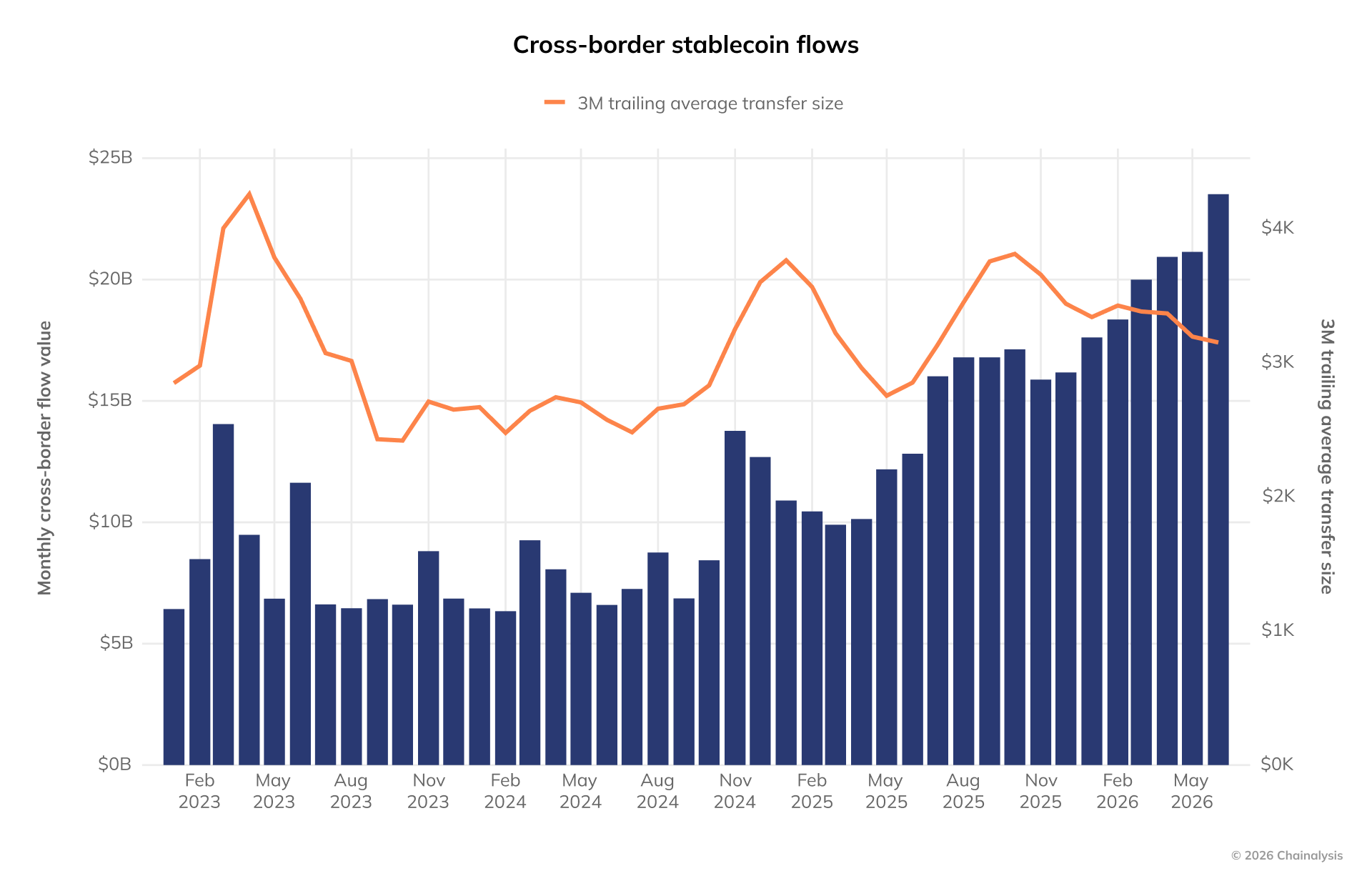
Crypto’s downturn over the last year has done little to slow stablecoins at the border, with cross-border stablecoin flows rising 77.5% in the year to June 2026 as the broader market lost more than a third of its value, according to new research from Chainalysis.
In its newly released 2026 Global Crypto Adoption Index, Chainalysis said cross-border stablecoin flows rose 77.5% to $220.3 billion in the 12 months ending June 2026, from $124.2 billion in the previous 12-month period, despite total crypto market capitalization falling 37% to $2.1 trillion over the same period.
“The bear market hit the price-sensitive half of crypto and left the payments half alone,” Chainalysis said.
The growth points to increasing crypto demand beyond speculative trading. Stablecoins, which are designed to maintain a stable value, often against fiat currency, have gained a foothold in mainstream finance. The US signed the GENIUS Act into law in July 2025, while the European Union’s MiCA rules and Hong Kong’s issuer licensing regime have brought stablecoins further within formal financial oversight.
Chainalysis said growth came from cross-border transfers averaging around $3,000, which is consistent with everyday use cases such as supplier payments, sending money home or moving savings out of volatile currencies.
“Activity has become consistent, routed through wallets in a steady rhythm rather than in bursts,” Philip Gradwell, vice president of economics at Tether, told Chainalysis. “That is the signature of trade and business activity, not speculation.”
Tianwei Liu, co-founder and CEO of StraitsX, told Cointelegraph that in Asia, fragmented currencies and payment systems have created demand for stablecoin settlement.
“That demand is also extending into everyday spending, with stablecoins sitting behind payment methods people already use,” Liu said.
However, outside of Asia, stablecoins address different needs, he said, including dollar access, remittances and protection against inflation or capital controls, such as across Latin America, Africa and the Middle East.
Related: Stablecoin growth could boost dollar dominance, US Treasury demand: BoE official
Chainalysis tracked 4,708 new cross-border corridors during the reporting period, carrying a combined $2.64 billion. Each corridor represents a route between an originating and receiving country.
Flows remained heavily concentrated in the top quarter of corridors, which accounted for 96.1% of measurable cross-border stablecoin value. The remaining three quarters carried $8.66 billion, up from $260 million in the previous period.
Vincent Chok, co-founder and CEO of First Digital, told Cointelegraph that while traditional payment structure remains effective for established corridors, it becomes fragmented as businesses move money between markets with different banking systems, currencies and settlement hours.
Stablecoins offer another option, he said, but it is still restrained by regulatory clarity, reliable redemption, access to local currencies and interoperability with existing financial systems.
“Onchain settlement is fast, but it doesn’t solve the off-chain parts: converting to local currency, meeting compliance requirements, and moving funds through existing banking rails,” Chok said.
Meanwhile, traditional remittance companies have expanded their stablecoin offerings this year.
Western Union launched a stablecoin wallet and Visa-linked card across 37 markets in August, allowing users to hold and spend its branded US dollar-backed stablecoin.
MoneyGram announced a similar card initiative in September, initially targeting Colombia, with additional markets planned later this year.
Magazine: Kyle Samani predicts SOL flippening, claims ‘no one’ uses ETH

 <!–>
<!–>
[–> Subscribe Cointelegraph is committed to independent, transparent journalism. This news article is produced in accordance with Cointelegraph’s Editorial Policy and aims to provide accurate and timely information. Readers are encouraged to verify information independently.
<!–>[–>26 minutes agoYohan Yun<!–>[–>
<!–>[–>1 hour agoHelen Partz<!–>[–>
<!–>[–>5 hours agoHelen Partz
<!–>[–>26 minutes agoYohan Yun<!–>[–>
<!–>[–>1 hour agoHelen Partz<!–>[–>
<!–>[–>5 hours agoHelen Partz
Zcash’s latest breakout is drawing fresh capital and leverage, pushing ZEC into a closely watched resistance zone.

Rising 2-year Treasury yields suggest prolonged high rates, impacting borrowing costs, investment strategies, and economic growth forecasts. The post Two-year US Treasury…
Intel's AI-driven surge highlights the growing importance of CPUs in AI workloads, potentially reshaping the semiconductor market landscape. The post Intel surges…

ESMA's focus on AI and tokenization oversight in 2027 signals a shift towards harmonized regulation, impacting innovation and compliance in EU finance.…