Bitcoin Traders Brace for These 4 Key Macro Events This Week
Here are the four major events likely to matter the most for BTC and the broader crypto market for the week ahead.
Bitcoin touched $77,711 intraday before recovering to near $78,225, spending a second consecutive session under macro stress as US Treasury yields held near multi-month highs. The 10-year yield reached 4.599%,…

Bitcoin touched $77,711 intraday before recovering to near $78,225, spending a second consecutive session under macro stress as US Treasury yields held near multi-month highs.
The 10-year yield reached 4.599%, while the 30-year climbed 11.8 basis points to 5.131%, its highest level since May 2025. BTC is down 3.9% from its May 15 opening above $81,000, with the same move pulling stocks and bonds lower alongside it.
The $77,700-$78,000 zone, already the next support shelf when BTC failed below $82,000, now carries the full weight of that macro test.
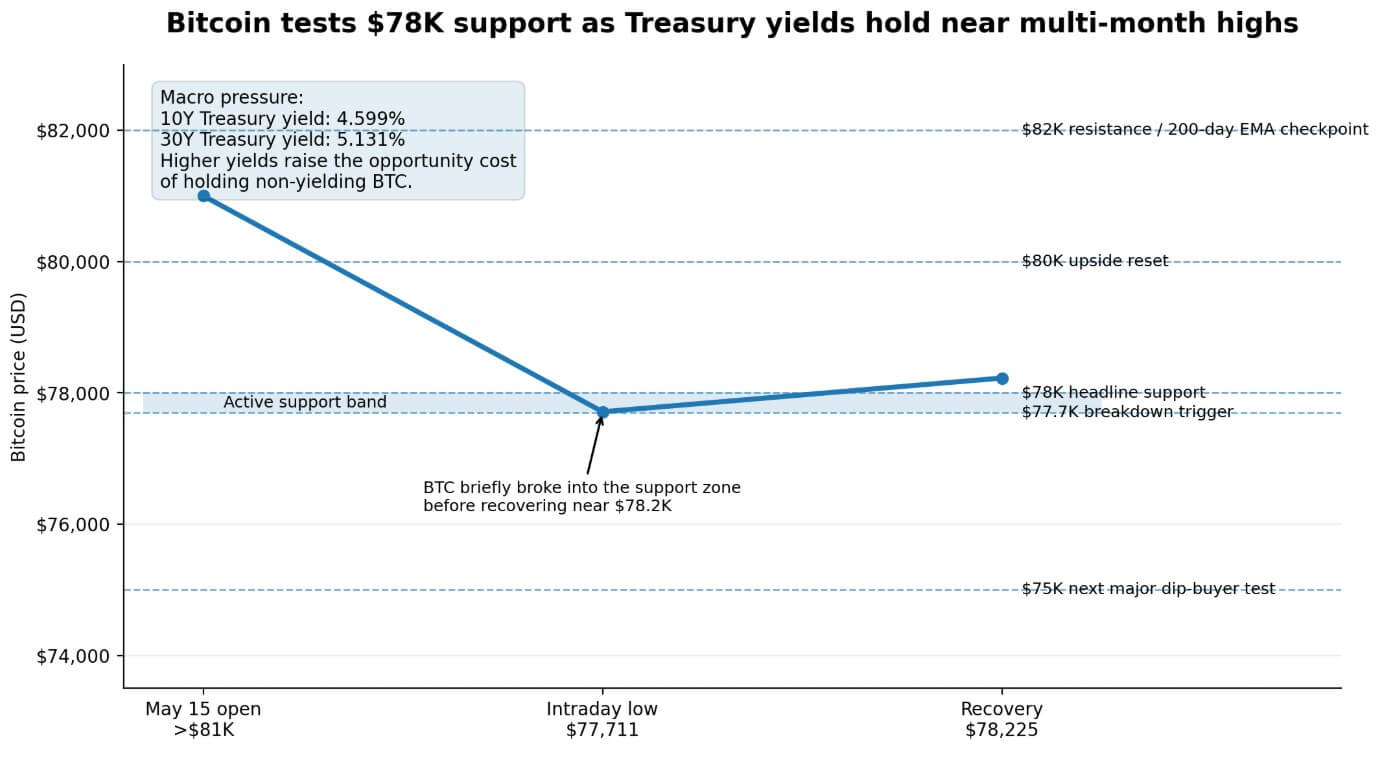
As a non-yielding asset, BTC now competes directly with a Treasury complex paying 4.5%-5.1%, and a rate floor at those levels raises the opportunity cost of holding it.
K33 data put Bitcoin’s 30-day correlation with Nasdaq futures above 0.7, and BTC’s beta to equity drawdowns tends to rise when Nasdaq sells hard.
Both channels are active in the current sell-off, and the macro backdrop leaves the Fed little room to ease either. April CPI accelerated to 3.8% year over year, up from 3.3% in March, while core CPI held at 2.8% and the energy index climbed 17.9% over the prior 12 months.
WTI settled at $105.42 on May 15, up 4.2% on the day and 11.33% over the month, while Brent reached $109.26, up 3.35%.
Trading Economics models Brent at $111.28 by quarter-end, and HSBC lifted its 2026 Brent forecast to $95 while modeling $110 average Brent if a supply deal arrives only toward late summer.
University of Michigan data put year-ahead inflation expectations at 4.5% in May, while the Fed’s April FOMC statement committed to assessing inflation before easing, both of which keep the policy-relief bar high.
CoinShares reported that Bitcoin investment products drew $706.1 million in inflows in the week ending May 11, suggesting a strong institutional bid.
Farside Investors’ daily US spot Bitcoin ETF data since then shows the bid has deteriorated to outflows of $630.4 million on May 13, inflows of $131.3 million on May 14, and outflows of $290.4 million on May 15.
That two-out-of-three outflow sequence strips the ETF buffer from the $78,000 support test exactly when it needs defending, the same buffer that absorbed macro headwinds in earlier weeks.
The live intraday low of $77,716.09 places BTC directly inside the support zone, and a daily close back above $78,000 keeps the correction technically contained.
A decisive loss of $77,700 opens the next downside sequence, in which $76,500 is the first follow-through target, and bears confirm the break, then $75,000 is the round-number zone when dip buyers historically need to show conviction.
A further extension would bring $73,000-$74,000 into view, a range that would reframe the pullback as macro-driven deleveraging across risk assets.
BTC level
Role
Trigger to watch
Market implication
$82,000
Major upside resistance / 200-day EMA checkpoint
Daily close above $82,000
Reframes the $78,000 test as a failed breakdown and opens room toward the high-$80,000s.
$80,000
First upside reset level
BTC reclaims $80,000 on a daily close
Weakens the bearish follow-through from the two-day selloff and sets up a retest of $82,000.
$78,000
Headline support
Daily close above $78,000
Keeps the correction technically contained and preserves the controlled-pullback narrative.
$77,700
Breakdown trigger
Decisive close below $77,700
Confirms support failure and shifts focus from stabilization to downside continuation.
$76,500
First downside target
BTC loses $77,700 and sellers follow through
Marks the first confirmation zone for bears after the $78,000 shelf breaks.
$75,000
Round-number dip-buyer test
Sustained pressure below $76,500
Tests whether dip buyers and long-term holders can absorb supply with conviction.
$74,000–$73,000
Deeper macro deleveraging zone
BTC fails to stabilize near $75,000
Reframes the move as a broader macro-driven drawdown across risk assets.
Reclaiming $80,000 is the first step toward neutralizing the bearish setup, as a daily close there breaks the lower-low sequence from the past two sessions and gives bulls a technically clean reset.
The harder task is at $82,000, as BTC traded below the 200-day exponential moving average near that level as of May 13, making it both a round-number ceiling and a technical checkpoint. A close above $82,000 would reframe the $78,000 test as a failed breakdown.
If the 10-year yield retreats below 4.50%, oil cools from current levels above $105 per barrel, and ETF flows flip positive, Bitcoin can reclaim $80,000.
That reclaim breaks the lower-low sequence over the past two sessions and sets up a retest of $82,000, the 200-day EMA level that BTC closed below on May 13.
A daily close above $82,000 would turn the yield-driven retreat into a failed breakdown, with room toward the high-$80,000s, reframing the past week as a corrective shakeout with the underlying accumulation thesis intact.
Scenario
BTC trigger
Macro condition
ETF-flow signal
Likely price path
Article framing
Bull reset
BTC reclaims $80,000, then closes above $82,000
10-year yield retreats below 4.50% and oil cools from above $105/bbl
Spot BTC ETF flows flip back positive
Retest of $82,000, then potential move toward the high-$80,000s
The selloff becomes a failed breakdown and a corrective shakeout.
Controlled correction
BTC holds daily closes around $77,700–$78,000
Yields remain elevated but stop rising aggressively
ETF flows remain mixed but outflows do not accelerate
Choppy range between $78,000 and $80,000
The correction stays contained while the market waits for macro stabilization.
Bear breakdown
BTC closes decisively below $77,700
10-year yield holds near 4.60% and inflation/oil pressure persists
ETF outflows continue
Drop toward $76,500, then $75,000
The support test fails and the market starts pricing a deeper macro-driven pullback.
Stress deleveraging
BTC loses $75,000 and fails to attract dip buyers
Long yields stay near multi-month highs; oil and inflation expectations remain elevated
ETF outflows deepen or become persistent
Move into $74,000–$73,000
The story shifts from normal correction to cross-asset deleveraging.
If BTC closes below $77,700 while Treasury yields hold near 4.60% and ETF outflows persist, the support test will confirm a breakdown.
The support at $76,500 is the first downside target, where bears confirm the break and the correction enters a new leg lower. The next level to watch is $75,000, the round-number zone where dip buyers historically need to absorb supply with real conviction.
A sustained move below $75,000 would push BTC toward the $74,000-$73,000 zone, a range that would reframe the correction as macro-driven deleveraging, with cross-asset repricing hitting equities and bonds, and spreading into BTC as well.
The macro inputs governing Bitcoin’s near-term direction need to stabilize before a recovery anchor forms.
The 10-year at 4.599% and the 30-year at 5.131% offer holders an income floor of 4.5%–5.1%. Bitcoin sits below that floor on carry, given its non-yielding status.
With year-ahead inflation expectations at 4.5% and the Fed still assessing conditions before moving, fast policy relief sits far from the market’s realistic pricing.
The $78,000 zone carries a structural test of whether ETF buyers and long-term holders can absorb the rate-driven cost fast enough to stabilize the price before the support shelf gives way.
Here are the four major events likely to matter the most for BTC and the broader crypto market for the week ahead.

Here are the four major events likely to matter the most for BTC and the broader crypto market for the week ahead.

Bitcoin is about to get a major bullish signal it hasn't had in over a year CoinDesk
Ethereum's liquidity challenges could lead to increased market volatility, impacting traders' strategies and potentially amplifying price swings. The post Ethereum surges nearly…