Money20/20 USA 2026: How Bitcoin, Stablecoins and AI Are Reshaping the Future of Finance
Bitcoin Magazine Money20/20 USA 2026: How Bitcoin, Stablecoins and AI Are Reshaping the Future of Finance From digital ownership to borderless value,…
Bitcoin exchange balances have recovered 84% of a six-week decline, weakening claims that ETF demand is creating an immediate shortage. Santiment data shows the reversal unfolded in less than three…

Published:Aug 17, 2026, 8:30 PMBitcoin Supply Squeeze Unwinds as 28,000 BTC Return to Exchanges
Bitcoin exchange balances have recovered 84% of a six-week decline, weakening claims that ETF demand is creating an immediate shortage. Santiment data shows the reversal unfolded in less than three weeks.
WRITTEN BY Kevin HelmsSHAREPublished: Aug 17, 2026, 8:30 PM
Bitcoin’s exchange supply reached its highest level since June 15, Santiment Intelligence shared on Aug. 17, challenging claims that spot bitcoin exchange-traded fund (ETF) buying was rapidly exhausting tradable inventory.
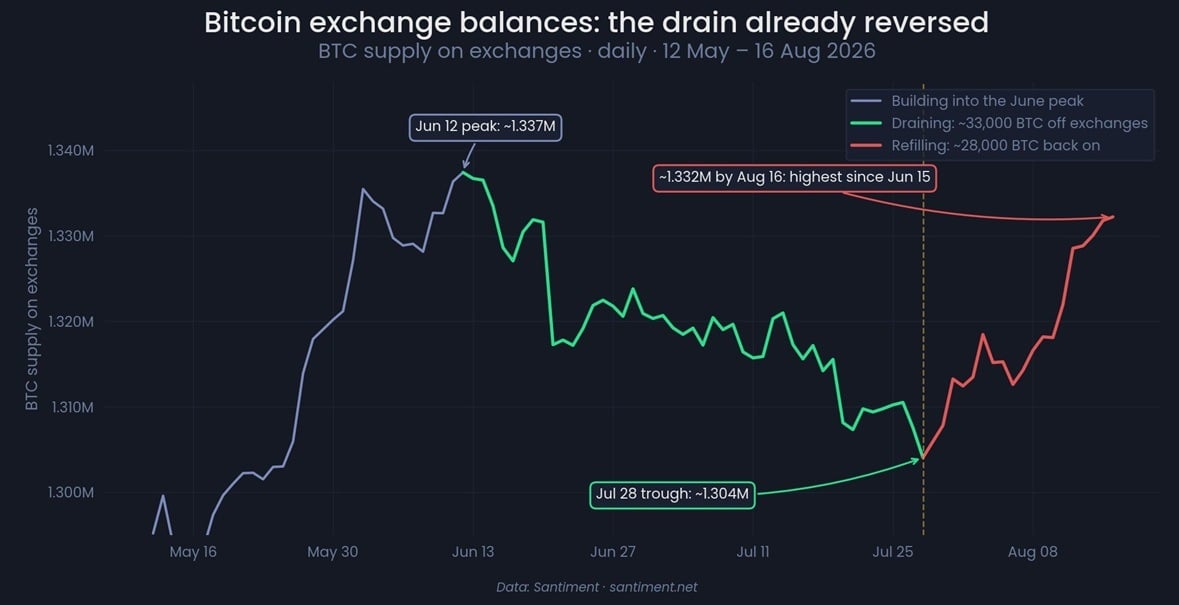
The initial six-week decline removed about 33,000 BTC from exchanges, lowering balances roughly 2.5% from 1.337 million on June 12 to 1.304 million on July 28. Santiment’s Supply on Exchanges metric captured the entire decline and subsequent refill within one data series.
The firm stated in its Aug. 17 X post, summarizing the complete balance reversal tracked by the metric:
“Balances bottomed on Jul 28 and have climbed to ~1.332M by Aug 16, about 28,000 BTC back on, roughly 84% of the drain undone.”
Strong ETF inflows and rising exchange reserves measure different parts of bitcoin’s market structure, so they can occur simultaneously without creating a data conflict. The Securities and Exchange Commission’s in-kind approval allows authorized participants to deliver bitcoin directly to eligible crypto funds in exchange for shares, rather than requiring every creation to begin with a cash-market purchase.
Net ETF flow measures net creations and redemptions in fund products, not the trading venue or wallet used to obtain the underlying coins. The spot bitcoin ETF creation process can involve cash purchases or in-kind bitcoin transfers, allowing authorized participants to source inventory from OTC desks, existing holders, or other off-exchange channels.
Centralized exchange balances instead reflect coins held in wallets that analytics providers attribute to trading platforms, making the metric a proxy for visible, readily tradable supply. The mechanics of centralized exchange custody and market depth help explain why a refill can expand available liquidity without identifying who deposited the coins or whether they are intended for sale.
Exchange balances had already shaped bitcoin’s scarcity narrative for months before the latest reversal began in late July. By March 15, the percentage of bitcoin held on centralized exchanges had fallen to its lowest level since November 2017, according to Santiment’s exchange supply data. The reading indicated that renewed institutional demand would face a smaller pool of readily tradable coins.
U.S. spot bitcoin ETFs drew $853.54 million during the first full week of August, posting five consecutive sessions of net inflows. Blackrock’s IBIT accounted for $693.5 million of the strongest weekly ETF inflow since April while Santiment’s data showed exchange balances were already climbing. The simultaneous moves showed that ETF demand did not require a corresponding decline in visible exchange supply.
The five-session inflow streak ended Aug. 10, and daily activity turned uneven during the following sessions. A subsequent $61.16 million bitcoin ETF outflow on Aug. 12 came mainly from Fidelity and Blackrock, illustrating that fund demand was not uniformly positive.
Noting that the refill had since flattened near 1.332 million BTC, leaving exchange supply about 5,200 coins below its June peak, Santiment Intelligence summarized the speed of the exchange-balance reversal:
“The squeeze took six weeks to build. It unwound in under three.”

Michael Saylor said Strategy’s STRC preferred stock gained 9% over one year while bitcoin lost 47%. The chart leaves out…
Read Now

Michael Saylor said Strategy’s STRC preferred stock gained 9% over one year while bitcoin lost 47%. The chart leaves out…
Read Now
Read Now
Michael Saylor said Strategy’s STRC preferred stock gained 9% over one year while bitcoin lost 47%. The chart leaves out…
Tags in this storyBitcoin (BTC)Exchange
Bitcoin Magazine Money20/20 USA 2026: How Bitcoin, Stablecoins and AI Are Reshaping the Future of Finance From digital ownership to borderless value,…
Managing your crypto taxes can become increasingly complicated as your activity starts spreading across multiple exchanges, wallets, blockchains, and DeFi protocols. CoinTracking…

Here's how investors are rapidly changing the way they seek exposure to major assets.


Eight of 13 cash sessions fell from September 21–October 7, 2026, but boundary checks and opposing ETF flows leave sustained institutional selling…