XRP Price Prediction: Analyst Calls $750 Ripple Next Year
XRP trades near $1.51 as resistance at $1.52–$1.56 caps price. Claver maintains a $10,000 forecast, but the near-term chart remains range-bound. The…
A proposal that seeks to implement a semi-voluntary redirect rate to subsidize the creation and operation of shared infrastructure by validators. If the majority of validators agree, the rate becomes…

Crypto NewsPublished:Jun 21, 2026, 7:40 PMEthereum Infrastructure Funding: Kleros Founder Proposes Protocol-Level Validator Redirect Rate
A proposal that seeks to implement a semi-voluntary redirect rate to subsidize the creation and operation of shared infrastructure by validators. If the majority of validators agree, the rate becomes mandatory for all, and they can choose which organization gets part or all of these funds.
WRITTEN BY Sergio GoschenkoSHAREPublished: Jun 21, 2026, 7:40 PM
A controversial proposal surged to tackle the problem of Ethereum’s joint infrastructure funding, which has been handled by the Ethereum Foundation or interested third parties until now.
Clément Lesaege, founder of Kleros and Proof of Humanity, argues that validators should be the ones taking the burden of these expenses, proposing establishing a redirect rate at the protocol level. This would allow them to direct part of their staking income to organizations managing these funds to collaborate with the Ethereum ecosystem.
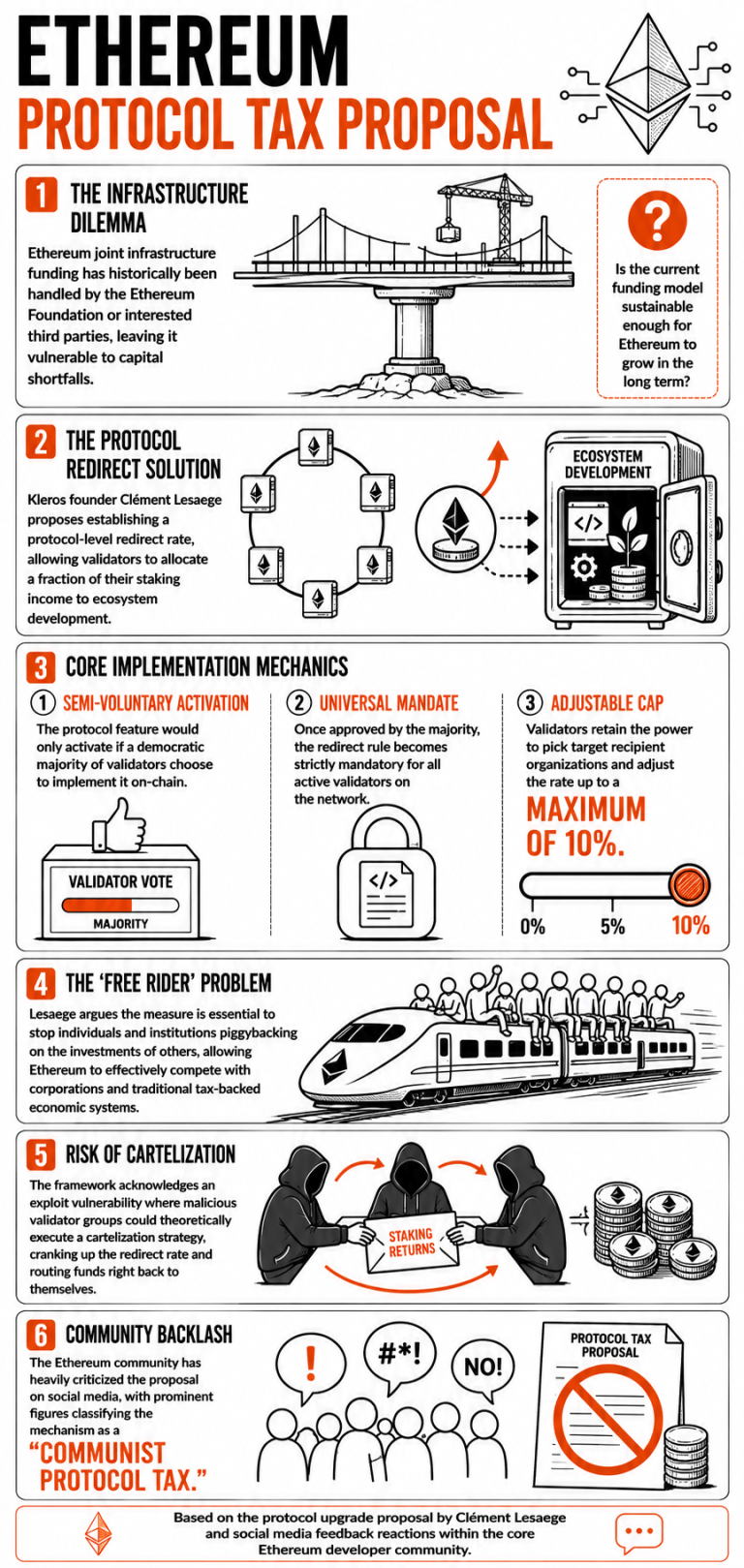
The proposal can be interpreted as a semi-voluntary expense: it would only activate if the majority of validators agree to implement it, but it turns mandatory for all validators in the Ethereum network after that point.
The recipients of these funds, and the percentage they receive, up to a maximum of 10%, can be set by validators at any point.
Lesaege stresses that a measure like this is fundamental to tackle the “free rider problem,” which consists of individuals and institutions piggybacking on the investments of others to take advantage of joint infrastructure and improvements.
“Successfully coordinating shared investment is essential to compete with both traditional economic systems that use coercive measures like taxation to reduce their deadweight loss and corporations that reinvest earnings back into future growth,” he stressed.
Even so, the proposal acknowledges that validator cartelization might arise, as validators might theoretically crank up the redirect rate and redirect those funds back to themselves.
Nonetheless, the proposal has been received by the Ethereum community with criticism on social media, which has even classified it as “communist” and also called it a “tax.”
“So paying taxes now? After the ethereum foundation kept dumping their own ethereum. What came out of this ecosystem anyway and was it all worth it?” said Via Network’s Romano.

The Ethereum network could face a slow-burning funding crisis within three to nine months, warned Trent Van Epps, adding that…
Read Now

The Ethereum network could face a slow-burning funding crisis within three to nine months, warned Trent Van Epps, adding that…
Read Now
Read Now
The Ethereum network could face a slow-burning funding crisis within three to nine months, warned Trent Van Epps, adding that…
Tags in this storyCryptocurrencyEthereum (ETH)
XRP trades near $1.51 as resistance at $1.52–$1.56 caps price. Claver maintains a $10,000 forecast, but the near-term chart remains range-bound. The…

XRP trades near $1.51 as resistance at $1.52–$1.56 caps price. Claver maintains a $10,000 forecast, but the near-term chart remains range-bound. The…

The escalating costs of AI training could lead to industry consolidation, limiting competition to a few major players, while cheaper inference may…

The escalating costs of AI training could lead to industry consolidation, limiting competition to a few major players, while cheaper inference may…