Ark buys $146 million in Anthropic shares last week, trims Ethereum and Solana Staking ETF holdings
Cathie Wood's Ark Invest has bought 1.64 million shares in Anthropic, worth $145.9 million, since its Thursday IPO.
A dated three-week entry estimate shows how direct deposits and pooled holdings bear the cost of inactive staking capital. Read the full story on CryptoSlateUnderstand the crypto stories that matter…

Make CryptoSlate preferred on
Share Share
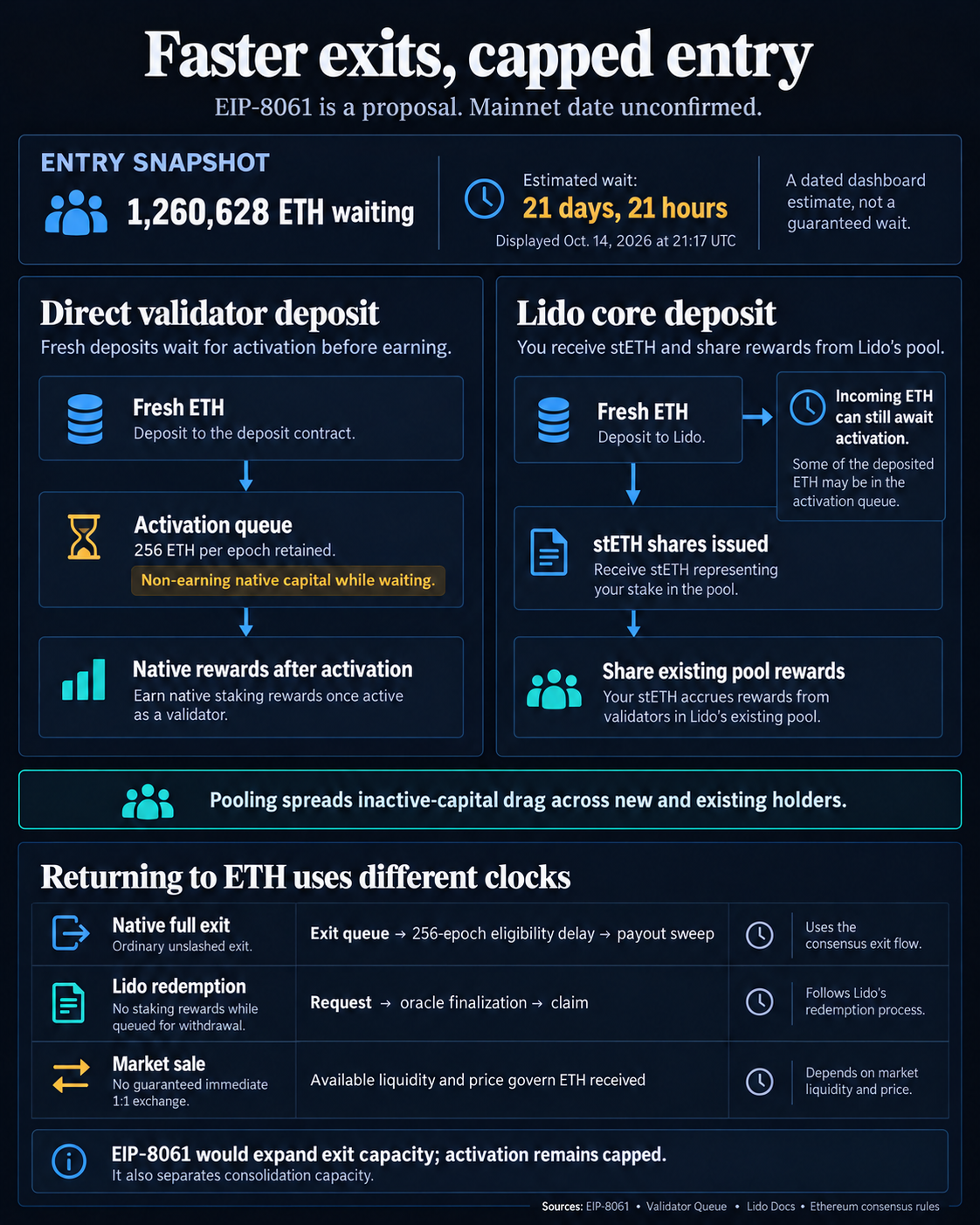
Ethereum staking could get faster exits under EIP-8061, but new validators would still have to wait for capped entry before earning rewards.
Validator Queue displayed 1,282,776 ETH waiting to enter staking and an estimated wait of 22 days, 6 hours when checked on Oct. 15. Its Oct. 14 snapshot, recorded at 21:17 UTC, showed 1,260,628 ETH and an estimated 21 days, 21 hours.
For a direct depositor, the delay postpones native staking income. A liquid staking pool such as Lido can give a new holder exposure to rewards from validators already working. The incoming ETH can still be waiting to activate, leaving more capital sharing those existing earnings.
EIP-8061 would retain the activation ceiling of 256 ETH per epoch. At 6.4 minutes per epoch, that amounts to 57,600 ETH a day when capacity is fully used.
The proposal would remove the fixed cap from exits and make exit capacity scale with active stake. It would also give validator consolidations their own capacity. Exits would remain rate-limited, even with a higher, stake-dependent allowance.
At 36 million ETH of stake, the authors’ worked example produces roughly four times the current capped exit capacity and twice the consolidation capacity.
As of Oct. 15, the EIP remained in Last Call, with a Nov. 1 deadline. Ethereum’s Glamsterdam roadmap listed it as scheduled for inclusion and expected mainnet in the fourth quarter, without a confirmed date. The mainnet consensus configuration had no activation epoch set for Gloas, Glamsterdam’s consensus fork.
A new direct validator deposit earns no native validator rewards while awaiting activation. Active validators earn ETH for their duties, so the economic hurdle is the time before that work begins.
The examples below use constant reward rates and exclude compounding, costs, taxes, penalties and alternative earnings. For 32 ETH inactive over the Oct. 14 snapshot’s estimated 21 days, 21 hours, or 21.875 days, multiply the assumed annual reward rate by 32 and by 21.875 divided by 365. This illustrates what an equally productive active stake could earn during that interval.
Assumed gross annual reward rateIllustrative gross rewards over the wait, 32 ETH2%0.038 ETH3%0.058 ETH4%0.077 ETH
Applying a 10% rewards fee to those illustrative active-stake benchmarks gives about 0.035, 0.052 and 0.069 ETH. Lido’s token integration guide documents that fee rate. A solo validator need not pay it.
When a user submits ETH to Lido’s mainnet core pool, the protocol issues stETH, its liquid staking token, and records the holder’s stake through shares. The funds can remain in the buffer or in Ethereum’s pending-deposit queue before earning native rewards.
Under Lido’s share accounting, a holder’s token balance reflects a share of the pool’s accounted ETH. That accounting includes buffered funds, active validator balances, pending deposits and deposits made since the last report. Lido’s separate staking vaults have their own collateral and share accounting; the example below concerns the core pool.
New core-pool shares can participate in subsequent reward distributions before the incoming ETH becomes productive.
If incoming capital stays inactive while existing validators produce the same rewards, those earnings are spread across more capital. Both incoming and incumbent holders share the reduced reward rate. Deposits add backing as well as shares; this is dilution of earnings per unit, not an immediate haircut to principal.
Using the same illustrative 3% gross reward rate and 10% rewards fee makes the effect visible. If all capital is productive, the approximate holder rate is 2.70%. If 5% is non-earning, it becomes 2.565%; if 10% is non-earning, it becomes 2.43%.
The calculation is the assumed gross rate multiplied by the productive fraction, then by 90% after fees.
Lido normally applies oracle-driven balance adjustments daily, but reports can be delayed and penalties can reduce balances. The fee is also governance-controlled.
For an ordinary, unslashed full validator exit, the network schedules an exit epoch through the exit queue. An online validator performing its duties can keep earning while waiting; reward eligibility ends at the exit epoch.
The consensus exit rules then impose a separate withdrawability delay of 256 epochs, about 27.3 hours at 6.4 minutes per epoch. The balance reaches the withdrawal address through a subsequent sweep. Faster exit processing would address the exit-queue stage of this journey without eliminating the later steps.
Lido has another process. A holder locks stETH in a FIFO withdrawal request, waits for oracle finalization and then claims the allocated ETH. Finalization depends on available funds, timing checks and any relevant losses. The requester receives no staking rewards accrued while the tokens wait in that queue, and significant losses can reduce the eventual payout.
The liquid buffer can help meet requests, but its entire balance is not automatically available for redemption. Lido’s implementation assigns a protected deposits reserve first, followed by a withdrawals reserve and then unreserved funds. CryptoSlate’s September coverage of that reserve explained how deposits and withdrawals can compete when the buffer is tight.
A secondary-market sale follows market conditions instead of the protocol’s withdrawal queue. Buying an existing stETH token transfers an outstanding claim; it does not require fresh ETH to pass through validator activation. Selling that token depends on available liquidity and market price, with no guaranteed immediate exchange for one ETH per stETH.
EIP-8061 would widen the exit lane while leaving entry capped at 57,600 ETH a day. Faster staking liquidity and earlier reward eligibility would remain different questions.
Article context
Related Asset Ethereum #2 ETH · $2,341.99 24-hour change: down 5.03% Loading price history… 24H Down 5.03% 7D Down 7.59% 30D Down 5.48% Related Asset
Lido Staked ETH STETH · $3,603.48 24-hour change: up 1.52% Related Company
Lido Liquidity for staked assets Related Company
Ethereum Foundation Promotes and supports the Ethereum platform Featured Analysis
Ethereum Technology Staking
Liam ‘Akiba’ Wright Editor-in-Chief • CryptoSlate
Also known as “Akiba,” Liam Wright is a reporter, podcast producer, and Editor-in-Chief at CryptoSlate. He believes that decentralized technology has the potential to make…
Layer-2
3 min read 20 hours ago
Oct 11, 2026
CryptoSlate may use AI tools to support research, editing, and production workflows. Our journalism remains human-led, with our editorial team responsible for every published article. Read our full AI usage disclaimer.
Our writers’ opinions are solely their own and do not reflect the opinion of CryptoSlate. None of the information you read on CryptoSlate should be taken as investment advice, nor does CryptoSlate endorse any project that may be mentioned or linked to in this article.
Buying and trading cryptocurrencies should be considered a high-risk activity. Please do your own due diligence before taking any action related to content within this article. Finally, CryptoSlate takes no responsibility should you lose money trading cryptocurrencies. For more information, see our company disclaimers.
Cathie Wood's Ark Invest has bought 1.64 million shares in Anthropic, worth $145.9 million, since its Thursday IPO.

South Korea's proactive measures to stabilize its stock market highlight the global interconnectedness of financial systems and investor sentiment. The post South…

South Korea's proactive measures to stabilize its stock market highlight the global interconnectedness of financial systems and investor sentiment. The post South…

Kraken's recurring NES token issues may erode user trust, highlighting the need for robust infrastructure and transparent communication. The post Kraken investigates…
