Bitcoin Traders Brace for These 4 Key Macro Events This Week
Here are the four major events likely to matter the most for BTC and the broader crypto market for the week ahead.
Bitcoin can serve investors who want direct ownership, amplified market exposure, or dollar income, according to Michael Saylor. His comparison puts historical volatility at 94% for Strategy’s common stock, 39%…
Published:Oct 5, 2026, 2:30 AM EDT BTC$86,231(+1.44%)
 ETH$2,727(+1.16%)Saylor Maps Three Bitcoin Paths With 94%, 39%, and 9% Volatility
Bitcoin can serve investors who want direct ownership, amplified market exposure, or dollar income, according to Michael Saylor. His comparison puts historical volatility at 94% for Strategy’s common stock, 39% for BTC, and 9% for its STRC preferred stock.
WRITTEN BY Kevin HelmsSHAREPublished: Oct 5, 2026, 2:30 AM EDT
Investors interested in bitcoin do not all want the same outcome, according to Michael Saylor, executive chairman of Strategy Inc. (Nasdaq: MSTR), a bitcoin treasury company. In comments shared Oct. 4, he presented BTC for people who want to own the asset, MSTR for those seeking amplified exposure, and STRC for those seeking dollar dividends.
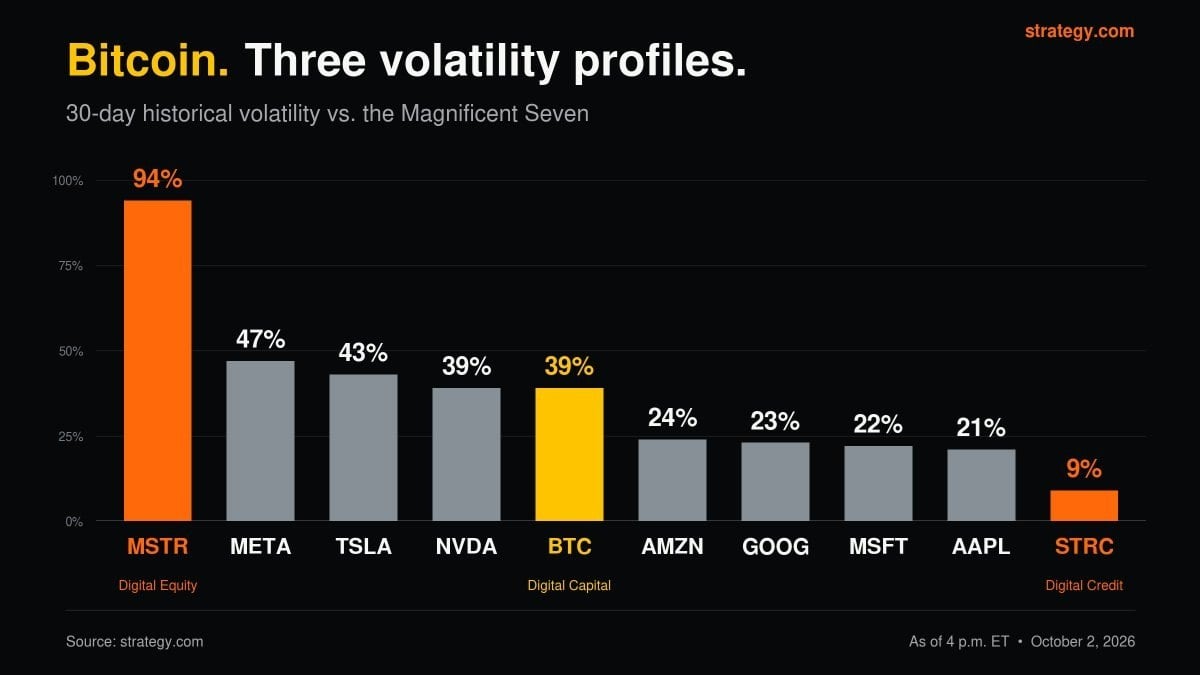
Saylor illustrated those differences with a comparison of BTC, MSTR, and STRC on X. The accompanying chart, dated Oct. 2, places MSTR at 94%, BTC at 39%, and STRC at 9%. MSTR’s historical price fluctuations were the largest, while STRC’s were the smallest. Subtracting STRC’s 9% from MSTR’s 94% produces an 85-percentage-point gap.
Saylor stated:
“Bitcoin can serve very different investors. $BTC offers direct ownership, $MSTR amplified exposure, and $STRC income with less 30-day price volatility than every Mag 7 stock. Digital Capital is the foundation for Digital Equity and Digital Credit.”
Volatility measures the size of price fluctuations, and the chart’s percentages describe past behavior rather than returns or guaranteed future outcomes. Strategy annualizes daily fluctuations over the last 30 trading days and uses Blackrock’s bitcoin exchange-traded fund, IBIT, as the bitcoin proxy. The Magnificent Seven technology stocks range from Apple’s 21% to Meta’s 47%, all above STRC’s 9%.
Buying BTC provides exposure to the asset itself, while purchasing corporate securities introduces the issuer’s obligations. Bitcoin operates on a decentralized network. MSTR holders own part of Strategy, rather than its coins directly. Saylor presents the common shares as a way to seek amplified exposure, with potentially larger gains and losses.
STRC holders instead own preferred stock, which has priority over common shares for dividends and liquidation proceeds. Debt holders rank ahead of STRC investors, whose payouts depend on the issuer’s financial capacity. The company’s STRC offering terms provide cumulative dividends, meaning unpaid amounts accumulate. Payments require legally available funds and declarations by the board.
Saylor calls BTC “digital capital,” meaning the underlying asset held by the company. In his framework, MSTR represents ownership in the business, while STRC offers a claim to dividend payments. His forecast of bitcoin serving as global digital capital envisions broader institutional use by 2036, with financial products built around the cryptocurrency.
STRC’s dividend mechanism seeks to encourage trading around its $100 stated amount by adjusting the annual rate monthly. Strategy’s variable dividend structure carries a 12% annualized rate for October, with cash payments twice monthly. That equals $12 annually per share if the rate remains unchanged; the yield at a particular purchase price can differ.
The income depends on company funding, since holding bitcoin itself generates no interest or dividend payments. Financing and cash reserves underpin Saylor’s explanation of Strategy’s dollar funding. The dividends come from Strategy, rather than the Bitcoin network. Preferred shares are not collateralized by the company’s coins, and smaller historical swings do not guarantee principal repayment.
Saylor’s broader argument is that investors can participate in a bitcoin-focused business without all holding the same type of investment. His vision for bitcoin-based capital markets includes products designed around ownership, amplified exposure, or income. During the measured period, MSTR’s reading was approximately 2.4 times BTC’s and more than 10 times STRC’s.
Strategy’s bitcoin holdings underpin a business that raises capital and pays investors dollar dividends. Michael Saylor outlined how the company…
Read Now: Bitcoin Pays No Coupon: Saylor Details Where Strategy Gets the Dollars

Strategy’s bitcoin holdings underpin a business that raises capital and pays investors dollar dividends. Michael Saylor outlined how the company…
Read Now: Bitcoin Pays No Coupon: Saylor Details Where Strategy Gets the Dollars
Read Now: Bitcoin Pays No Coupon: Saylor Details Where Strategy Gets the Dollars
Strategy’s bitcoin holdings underpin a business that raises capital and pays investors dollar dividends. Michael Saylor outlined how the company…
Here are the four major events likely to matter the most for BTC and the broader crypto market for the week ahead.

Here are the four major events likely to matter the most for BTC and the broader crypto market for the week ahead.

Bitcoin is about to get a major bullish signal it hasn't had in over a year CoinDesk
Ethereum's liquidity challenges could lead to increased market volatility, impacting traders' strategies and potentially amplifying price swings. The post Ethereum surges nearly…