Plume launches nBND vault backed by Fidelity Total Bond ETF
Plume's nBND vault could accelerate institutional adoption of tokenized assets, blending traditional finance with blockchain innovation. The post Plume launches nBND vault…
Coinbase CEO Brian Armstrong intensified pressure for a Senate vote, portraying the CLARITY Act as a bipartisan breakthrough that could strengthen consumer protections, law enforcement authority, and American leadership in…

Regulation & LegalPublished:Jul 27, 2026, 10:30 PMThe CLARITY Act Is at the One-Yard Line: Coinbase Says ‘It’s Time to Get It Over the Finish Line’
Coinbase CEO Brian Armstrong intensified pressure for a Senate vote, portraying the CLARITY Act as a bipartisan breakthrough that could strengthen consumer protections, law enforcement authority, and American leadership in digital assets.
WRITTEN BY Kevin HelmsSHAREPublished: Jul 27, 2026, 10:30 PM
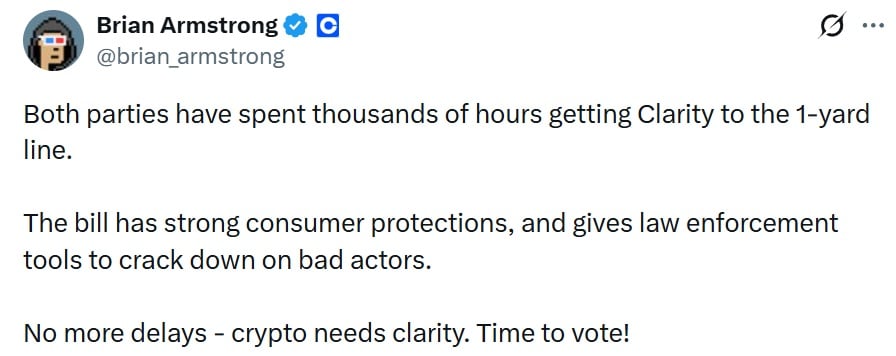
Crypto exchange Coinbase (Nasdaq: COIN) CEO Brian Armstrong urged lawmakers in an X post on July 27 to advance the CLARITY Act, arguing that the bipartisan proposal would strengthen consumer protections, expand law enforcement tools, and deliver regulatory clarity for the cryptocurrency industry.
Calling for an immediate vote, the Coinbase executive maintained that lawmakers had spent thousands of hours developing the compromise and should complete the legislative process without further delays.
The X post also included a clip from Armstrong’s July 21 CNBC interview, where he described the legislation as the product of years of bipartisan negotiations.
Armstrong remarked:
“The CLARITY Act is at the one-yard line, and it reflects the work from both sides of the aisle, spending thousands of hours along with their staff to get a true bipartisan compromise.”
The Coinbase CEO used the football metaphor to argue that the legislation is extremely close to advancing and should receive a final Senate vote without further delay.
The executive also argued that the proposal would expand law enforcement authority, establish new consumer protections, and provide a federal framework for the digital asset industry.
“This bill would strengthen power for law enforcement. It would bring new consumer protections, and you have to remember the status quo is that we don’t have any federal laws protecting consumers or helping this industry get built in the United States, so the status quo is not going to work,” Armstrong explained, concluding:
“This bill is a dramatic benefit to the United States of America, and it’s time to get it over the finish line.”
Senate Republicans released updated CLARITY Act text on July 22, reflecting negotiations involving the Senate banking and agriculture committees. The accompanying CLARITY Act section-by-section summary outlines disclosure standards, registration requirements, anti-fraud provisions, and expanded anti-money-laundering obligations for digital asset market participants.
Political pressure surrounding the CLARITY Act has intensified after Stand With Crypto announced that CLARITY Act votes will be scored. The organization has indicated that lawmakers’ positions on the legislation will become part of its public scorecard, potentially influencing millions of cryptocurrency voters.
Institutional backing has also widened, with Blackrock backing the CLARITY Act alongside support from Fidelity Investments, Charles Schwab, and Goldman Sachs CEO David Solomon, as established financial leaders have urged Congress to approve a federal market structure framework before the available legislative window closes.
Election-year scheduling has raised the stakes further as the Senate timeline narrows before the midterms, leaving floor action as the next major test for the market structure legislation.

Galaxy Research lowered its estimate for the CLARITY Act becoming law in 2026 to 30% after lawmakers released final text…
Read Now

Galaxy Research lowered its estimate for the CLARITY Act becoming law in 2026 to 30% after lawmakers released final text…
Read Now
Read Now
Galaxy Research lowered its estimate for the CLARITY Act becoming law in 2026 to 30% after lawmakers released final text…
Tags in this storyBrian ArmstrongCLARITY ActCoinbase
Plume's nBND vault could accelerate institutional adoption of tokenized assets, blending traditional finance with blockchain innovation. The post Plume launches nBND vault…
OKXICE has notified the SEC that it intends to launch a tokenized securities trading venue under the innovation exemption.

The US debt spiral is not imminent as 8.5% growth outpaces the 3.4% average rate on federal debt despite 5% yields. The…
While some national polls favored President Lula over Senator Flávio Bolsonaro, Polymarket accurately predicted the opposite outcome days before the polls, giving…
