Clarity Act Uncertainty Keeps DeFi’s Bigger Market Bet on Hold
The CLARITY Act could expand DeFi into tokenized equity and bond markets, but Senate uncertainty is keeping institutional capital on the sidelines.…
U.S. President Donald Trump is reportedly withholding his signature from a sweeping housing bill that would bar the Federal Reserve from issuing a central bank digital currency (CBDC) through 2030,…

Crypto NewsPublished:Jun 29, 2026, 3:31 AMTrump Holds Up CBDC Ban Through 2030 as He Demands a Voter-ID Law
U.S. President Donald Trump is reportedly withholding his signature from a sweeping housing bill that would bar the Federal Reserve from issuing a central bank digital currency (CBDC) through 2030, tying the measure to a separate voter-eligibility law that the Senate has already rejected.
WRITTEN BY Shiraz JagatiSHAREPublished: Jun 29, 2026, 3:31 AM
The 21st Century ROAD to Housing Act passed both chambers of Congress with overwhelming bipartisan support, carrying a four-year prohibition on a Federal Reserve digital dollar. The Senate cleared the package in an 85-5 vote on June 22, and the House of Representatives followed with a 358-32 vote, sending the bill to the president’s desk. Yet Trump declined to sign it on schedule, abruptly canceling a planned signing ceremony.

The reason is not the digital-dollar language, which the White House supports, but a piece of unrelated legislation. Trump has said he will not sign the housing bill until Congress sends him a separate measure requiring proof of citizenship to register to vote.
Trump has framed the impasse as a matter of party discipline rather than disagreement over the CBDC provision. He told reporters the Republican party remains “well-unified,” even as he refuses to stage a signing ceremony until lawmakers act on the voter measure.
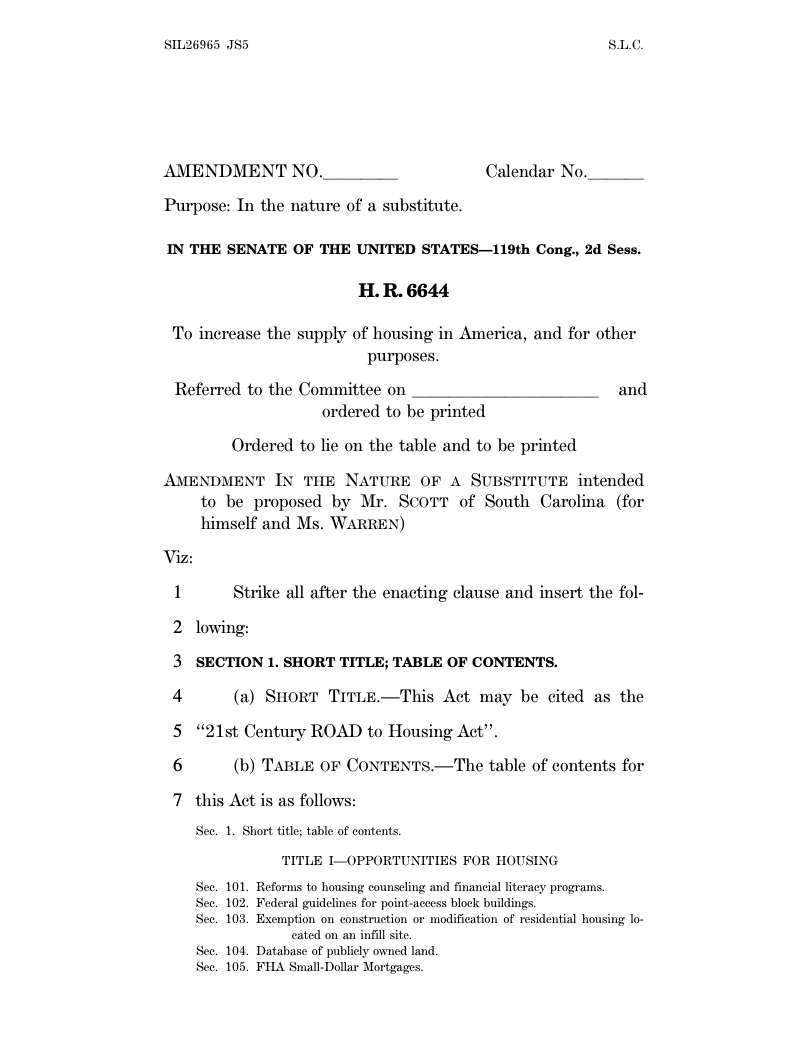
The CBDC provision itself bars the Board of Governors of the Federal Reserve System, or any Federal Reserve bank, from issuing, creating, or circulating a central bank digital currency (directly or through any intermediary) through December 31, 2030.
A central bank digital currency is a government-issued digital form of a nation’s money. The bill carves out an explicit exemption for private dollar-denominated stablecoins that are “open, permissionless, and private,” shielding tokens issued by companies such as Circle and Tether from the ban.
The legislation Trump is holding out for is the Safeguarding American Voter Eligibility Act, which would require documentary proof of citizenship to register for federal elections. That bill failed its most recent Senate vote on June 4, falling 48-50, with four Republicans (Senators Susan Collins, Lisa Murkowski, Mitch McConnell, and Thom Tillis) joining every Democrat to block it. Senate Majority Leader John Thune has since signaled he is unlikely to bring it back to the floor this session, leaving the standoff without an obvious resolution.
The delay has drawn criticism from both sides of the aisle. Democrats have accused the president of holding popular housing relief hostage to an unrelated partisan priority, while Republican leaders have urged patience and insisted the party remains united.
Trump laid the groundwork for the prohibition in January 2025, when he signed an executive order barring his administration from any work on a retail digital dollar. He warned at the time that a government-run digital currency would threaten “the stability of the financial system, individual privacy, and the sovereignty of the United States.” Crypto advocates have long argued that a Fed CBDC could enable government surveillance of transactions, and the industry has lobbied to write the ban into law.
Because the housing package passed both chambers with margins well beyond the two-thirds threshold needed to override a veto, the ban is widely expected to become law in the coming days regardless of whether Trump stages a signing event. Bitcoin.com News reported earlier that the Senate adopted the four-year ban in its 85-5 vote, a result the digital-asset industry hailed as one of its clearest legislative wins of the year.
The push to block a US digital dollar comes as stablecoins, privately issued tokens pegged to the dollar, have become a central battleground in Washington. Lawmakers passed the GENIUS Act in July 2025 to regulate payment stablecoins, and six federal agencies are racing to finalize the rules by a July 18, 2026 deadline. By drawing a hard line against a state-issued CBDC while leaving room for private stablecoins, the housing bill reflects the approach U.S. policymakers have increasingly favored: let the private sector issue digital dollars under federal supervision, and keep the central bank out of retail money.
Internationally, the U.S. stance runs against the grain. More than 130 countries representing the bulk of global gross domestic product (GDP) have explored central bank digital currencies, and several (including China with its digital yuan) have moved to pilot or launch them. A four-year U.S. ban would leave the world’s largest economy on the sidelines of a technology its main geopolitical rivals are actively deploying.
The next step is whether Trump relents, Congress revisits the voter bill, or the housing package becomes law without a presidential signature once the constitutional clock runs out. Either way, a U.S. central bank digital currency would remain off the table until the end of the decade.

The U.S. Senate passed the 21st Century ROAD to Housing Act late Monday in an 85-5 vote, attaching a four-year…
Read Now

The U.S. Senate passed the 21st Century ROAD to Housing Act late Monday in an 85-5 vote, attaching a four-year…
Read Now
Read Now
The U.S. Senate passed the 21st Century ROAD to Housing Act late Monday in an 85-5 vote, attaching a four-year…
Tags in this storyCBDCCLARITY ActDonald TrumpGENIUS ActTrump
The CLARITY Act could expand DeFi into tokenized equity and bond markets, but Senate uncertainty is keeping institutional capital on the sidelines.…
The OCC issued preliminary conditional approval on August 14, 2026, for World Liberty Trust Company, National Association, to charter as a national…

This comes after a continuous few weeks of selling its stash.

USDT and USDC contracts move from the next period, while returning to four-hour settlement requires 36 stable hours. The post KuCoin’s new…