Clarity Act Uncertainty Keeps DeFi’s Bigger Market Bet on Hold
The CLARITY Act could expand DeFi into tokenized equity and bond markets, but Senate uncertainty is keeping institutional capital on the sidelines.…
This partnership enhances financial inclusion by providing a vast cash network for crypto users, potentially disrupting traditional remittance services. The post MoneyGram and Kraken launch Bitcoin-to-cash withdrawals across 100 countries…
MoneyGram and Kraken launch Bitcoin-to-cash withdrawals across 100 countries
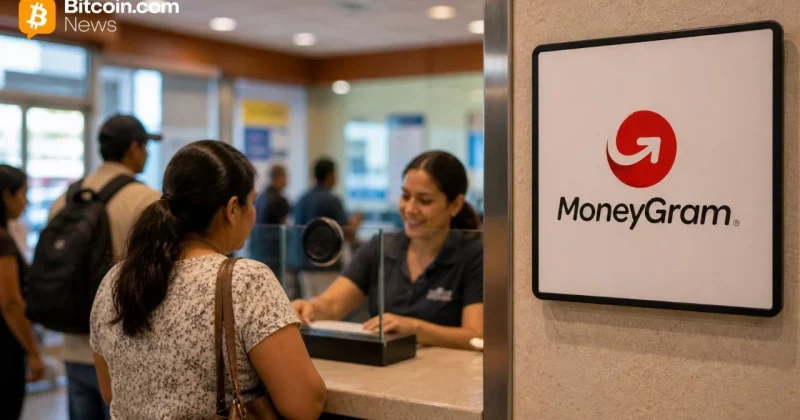
The partnership connects Kraken’s crypto exchange to nearly 500,000 MoneyGram retail locations, creating one of the largest fiat off-ramps in the industry.
Just now ago
Share
Add us on Google
Here’s a problem that’s plagued crypto since its inception: turning digital money into the paper kind. Sure, you can sell Bitcoin on an exchange and wire funds to your bank. But for billions of people worldwide who rely on cash, or who lack traditional bank accounts entirely, that process ranges from inconvenient to impossible.
Kraken and MoneyGram just took a sledgehammer to that wall. The two companies announced a partnership that lets Kraken users convert digital assets directly into cash at roughly 500,000 MoneyGram locations across more than 100 countries. The service supports hundreds of fiat currencies and offers instant or near-instant payouts.
Think of it like an ATM network, except instead of machines bolted to walls, it’s the corner shops, post offices, and retail counters where MoneyGram already operates. A Kraken user initiates a withdrawal through the exchange, and picks up physical cash at a nearby MoneyGram agent location.
The division of labor is clean. Kraken handles customer onboarding, identity verification, and regulatory compliance on the crypto side. MoneyGram provides its licensed money transmission infrastructure, the thing it’s been building for over 85 years.
Advertisement
The rollout is phased, covering the US, Europe, Latin America, Africa, and parts of Asia Pacific. Future plans include local bank deposits and cross-border remittance flows through the Kraken app.
Nearly 500,000 physical locations in over 100 countries is not a pilot program. It’s infrastructure. To put it in context, there are roughly 470,000 bank branches in the entire European Union. Kraken users now have access to a cash network of comparable density, except it spans every inhabited continent.
The timing matters too. Kraken, founded in 2011, has spent years positioning itself as the compliance-first exchange. MoneyGram, for its part, has been steadily leaning into blockchain technology. On June 2, 2026, MoneyGram launched its own native stablecoin, MGUSD, built on the Stellar blockchain.
If you’re a construction worker in Guatemala who receives Bitcoin from a relative in the US, you now have a path to walk into a local shop and get quetzales. That’s not a whitepaper promise. That’s plumbing.
For Kraken specifically, this is a competitive play against Coinbase, Binance, and other major exchanges. None of them currently offer cash pickup at anything close to this scale.
The remittance angle deserves particular attention. Global remittance flows run into the hundreds of billions of dollars annually, and traditional providers typically charge fees that eat into transfers sent by people who can least afford it. If the planned cross-border remittance feature materializes through the Kraken app, it would put the exchange in direct competition with Western Union, Wise, and MoneyGram’s own traditional remittance business.
There are risks worth watching. Regulatory fragmentation across 100-plus countries means compliance will be a moving target. Anti-money laundering rules vary dramatically between, say, Nigeria and Norway. Kraken’s assumption of compliance responsibilities is a bold commitment, and the execution will be tested market by market.
The stablecoin piece adds another variable. MGUSD on Stellar is an interesting choice, but the stablecoin market is brutally competitive and increasingly subject to regulatory frameworks like the EU’s MiCA. Whether MGUSD gains meaningful traction depends on whether MoneyGram can create use cases that existing stablecoins like USDC and USDT don’t already serve.
Disclosure: This article was edited by Editorial Team. For more information on how we create and review content, see our Editorial Policy.
The CLARITY Act could expand DeFi into tokenized equity and bond markets, but Senate uncertainty is keeping institutional capital on the sidelines.…

The OCC issued preliminary conditional approval on August 14, 2026, for World Liberty Trust Company, National Association, to charter as a national…
This comes after a continuous few weeks of selling its stash.
USDT and USDC contracts move from the next period, while returning to four-hour settlement requires 36 stable hours. The post KuCoin’s new…